Quarry stone quantity planner

Trap Rock Calculator

A 100 sq ft layer of trap rock at a finished 3 in depth takes 25 cu ft (0.93 cu yd). At Dresser Trap Rock’s example loose weight of 2,600 lb/cu yd, that is about 1.20 US short tons before any optional extra. Change the weight to match your supplier’s product.

Rock family:Basalt and diabase trap rock
Buying units:Cubic yards or US short tons
Weight example:2,600 lb/cu yd; editable
0.93 cu yd
100 sq ft at 3 in
Finished layer volume before optional extra.
1.20 tons
Same example
At Dresser Trap Rock’s 2,600 lb/cu yd average.
83 sq ft
Per short ton at 3 in
Changes when the supplier’s bulk weight changes.

Measure → convert → order

Calculate the layer first, then its weight

Volume comes from the space you are filling. Tons depend on the particular trap-rock product and its loose bulk weight. Keep those two measurements separate when you call the yard.

How do you know the area?

Use extra only for a measured uneven subgrade, spillage, or another site reason. This is an order allowance, not a fixed “trap rock compaction” rate.

Starts at Dresser Trap Rock’s listed 1.3 US short tons per cubic yard. Fick lists 2,700 lb/cu yd for its 3/4–1 in product. Your material may differ.

Installed layer

0.93cu yd

25.00 cu ft before optional extra

Planned bulk order0.93 cu yd
Estimated US short tons1.20 tons
One ton covers at this depth83.1 sq ft
Measured area100 sq ft

The ton figure estimates loose material from the weight entered. Ask whether your supplier sells by measured tons or bucket volume, and whether delivery has a minimum.

Already have a quote?

How far will those tons go?

Use the same depth and supplier weight above to estimate the geometric area for material offered by the ton.

83.1 sq ft

The calculation

A 20 × 5 ft area at 3 inches

Measure only the part that will receive trap rock. This 100 sq ft layer is 25 cu ft (100 × 3 ÷ 12) or 0.93 cu yd (25 ÷ 27). Using Dresser’s 2,600 lb/cu yd average, its estimated loose ordering weight is 2,407 lb, or 1.20 US short tons. The volume is the same if another supplier’s product weighs more or less.

Finished cu ft = area (sq ft) × finished depth (in) ÷ 12

Planned cu yd = finished cu ft × (1 + optional extra ÷ 100) ÷ 27

US short tons = planned cu yd × supplier lb/cu yd ÷ 2,000

Supplier coverage suggestions are useful for shopping, but a range such as “2–3 inches” cannot yield one exact square-foot figure. Choose a finished depth first, then compare the estimate with the yard’s product guidance.
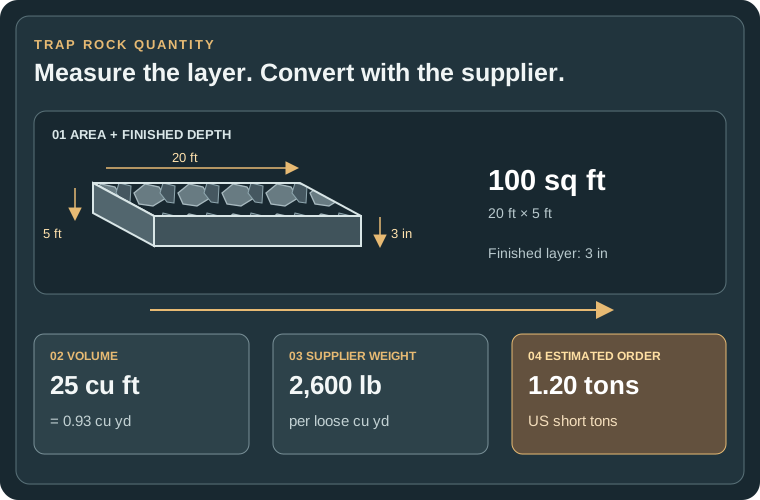
A measured 20 by 5 foot trap rock area with a 3 inch finished layer becomes 25 cubic feet, 0.93 cubic yard, and about 1.20 short tons at 2,600 pounds per cubic yard.
The layer dimensions fix the volume; the supplier’s loose bulk weight converts that volume to tons. Swipe for the full diagram on a narrow screen.

Name the product

“Trap rock” is a rock type, not one gradation

USGS groups basalt and diabase under trap rock. A quarry then crushes and screens that rock into different products. Dresser’s current schedule separately lists 3/4 in rock, 3/4 in Class 5 base, and drain-field stone. Ask for the product name and size range, not only the geological name.

01 / CLEAN

Open-graded crushed rock

Little fine material leaves spaces between pieces. Check the actual product specification for a drain trench, an open-graded base, or a contained decorative surface. It may move under tires if used as an unsupported driveway wearing course.

02 / GRADED

Minus or Class 5 base

A range of coarse and fine particles is intended to compact into a firmer base. FHWA distinguishes dense-graded structural bases from open-graded drainage layers. Ask the yard for its compaction guidance and loose delivery weight.

03 / LARGE

Drain-field or erosion stone

Larger screened rock serves a different design. Dresser lists a 1–4 in drain-field product and still larger erosion sizes. Use the project specification for size and thickness; a 3 in decorative-layer example should not be copied to those applications.

Reference

Coverage changes with finished depth

These are geometric yields at the 2,600 lb/cu yd example weight, before any order extra. One cubic yard always contains 27 cu ft; the square feet per short ton depend on bulk weight. For another product, change the calculator field.

Finished depthSq ft per cu ydSq ft per short ton100 sq ft needs
2 in162124.60.62 cu yd / 0.80 ton
3 in10883.10.93 cu yd / 1.20 tons
4 in8162.31.23 cu yd / 1.60 tons

Rounded table values are for estimating. Check the chosen stone size against the layer depth; larger rock may need a deeper layer or a different construction detail.

Before you call the quarry

Four details that make a useful quote

Bring a material takeoff that a supplier can verify. It is especially useful when the same yard stocks clean decorative trap, compactable base, and larger drainage or erosion grades.

  1. State the use and grade. A driveway base, visible stone bed, and pipe trench call for different gradations. Ask for the full product name and size range.
  2. Give area and finished depth. Measure the actual footprint, deduct large features, and note low spots separately. See the depth guide for layer planning.
  3. Confirm units and weight. Ask whether the quote is by cubic yard or US short ton and what loose weight per cubic yard they use for that load. A truck scale ticket is a delivered weight; it does not prove a universal density.
  4. Check delivery and placement. Confirm the minimum order, drop location, access, and whether the grade you chose is currently available. Keep clean drain stone separate from any base containing fines.

Source notes and practical limits

The Dresser Trap Rock 2026 product schedule supplies the 1.3-short-ton/cu-yd starting value and shows separate gradations. Fick’s 3/4–1 in listing uses 2,700 lb/cu yd, illustrating why the field is editable. The FHWA granular-base guide explains how grading and fines affect base stability and drainage. The calculator estimates material volume; it cannot select a structural pavement design or predict the exact weight of a wet, graded delivery.

Trap rock questions

How much trap rock do I need for 100 square feet?

At a finished depth of 3 inches, 100 square feet requires 25 cubic feet, or 0.93 cubic yard, before any optional order extra. Using Dresser Trap Rock’s average 2,600 pounds per cubic yard, that volume is about 1.20 US short tons. Ask your supplier for the loose bulk weight of the exact gradation you are buying.

How many square feet will one ton of trap rock cover?

At 3 inches deep and an example loose bulk weight of 2,600 pounds per cubic yard, one US short ton covers about 83 square feet by volume. At 2 inches it covers about 125 square feet; at 4 inches, about 62. Product weight, finished depth, grading, and uneven ground change the estimate.

How much does a cubic yard of trap rock weigh?

There is no single weight for every trap-rock gradation. Dresser Trap Rock lists an average of 1.3 US short tons (2,600 pounds) per cubic yard. Fick Supply lists 2,700 pounds per cubic yard for its 3/4- to 1-inch trap rock. Enter the weight given by your seller before converting cubic yards to tons.

Is clean trap rock the same as trap-rock driveway base?

No. Clean crushed trap rock has little fine material and is sold for uses such as drainage and decorative beds. Minus or Class 5 base contains a range of smaller particles that can compact into a firmer layer. Dresser lists these as separate products. Select the gradation for the intended layer, then use its own supplier weight.

Can I use trap rock in a French drain?

A clean, open-graded trap-rock product can be used where the drain design calls for that size and grading. A dense-graded driveway base containing fines is a different product and can obstruct the open spaces that carry water. For a pipe trench, use the Drain Rock Calculator to account for pipe displacement and the actual stone envelope.

Quarry Knowledge Network

Complete Landscape Aggregate Calculator Library

Explore material calculators, unit conversions, and practical field guides by project.

Material Calculators (20)

Core Landscape Rocks
Specialty and Base Aggregates

Conversion Calculators (28)

Generic Volume and Weight
Material Specific Conversions

River Rock Coverage Calculator

Coverage Solver

Convert river rock tons, yards, or bags to area at your depth and supplier bulk weight.

Gravel Tons Calculator

Tons Solver

Estimate US short tons with a supplier-specific loose bulk density.

Gravel Cubic Yards Calculator

Yards Solver

Measure finished gravel volume and plan a rounded bulk-yard order.

Gravel Bag Calculator

Bag Solver

Count bags by labeled volume and compare current bag and bulk quotes.

Crushed Stone Tons Calculator

Tons

Estimate short tons from depth and editable supplier bulk weight.

Crushed Stone Yardage Calculator

Yards

Round cubic yards to a supplier increment and plan delivery capacity.

Crushed Stone Bag Calculator

Bags

Count whole bags using the product label and compare local quotes.

River Rock Tons Calculator

Tons Solver

Estimate US short tons from measured area, depth, and editable supplier bulk weight.

River Rock Cubic Yard Calculator

Yards Solver

Separate installed yards from extra and round a bulk order to the supplier increment.

River Rock Bag Calculator

Bag Solver

Count bags from their labeled volume and compare current bag and bulk quotes.

Pea Gravel Patio Calculator

Patio Solver

Estimate separate pea gravel and base layers with editable depths and planning assumptions.

Pea Gravel Tons Calculator

Tons Solver

Estimate US short tons for a measured pea gravel layer with editable loose bulk density.

Pea Gravel Cubic Yard Calculator

Yards Solver

Separate measured layer volume from optional extra cubic yards for a bulk order.

Pea Gravel Bag Calculator

Bag Solver

Count retail pea gravel bags using the volume printed on your chosen bag.

Pea Gravel Coverage Calculator

Coverage Solver

Convert pea gravel tons, yards, or bags to area, or estimate an order from area and depth.

Decomposed Granite Tons Calculator

Tons Solver

Convert finished DG layer volume to loose order yards and short tons with editable assumptions.

Decomposed Granite Coverage Calculator

Coverage Solver

Estimate finished DG area per loose cubic yard or short ton at a chosen depth.

Lava Rock Bag Calculator

Bag Solver

Count whole landscape-lava bags from the label volume and estimate carrying weight.

Lava Rock Coverage Calculator

Coverage Solver

Convert known lava-rock yards, tons, or bags to area at a chosen depth.

Marble Chips Bag Calculator

Bag Solver

Count whole white marble chip bags from the volume printed on the chosen product.