The package matters
Use cubic feet for quantity, pounds for hauling
A bag is a container, not a standard measure of stone. For a volume-labeled product, divide the stone volume your bed needs by the dry volume printed on the package, then round up to a whole bag. A 0.5 cu ft bag is common, but the calculator lets you replace it.
Do not turn a weight-only label into cubic feet using a universal “pounds per bag” rule. Even half-cubic-foot products differ: Vigoro river pebbles list 50 lb, Lowe's DecoRock lists 44 lb, and Vigoro creek rock lists 40 lb. If only weight is shown, use the maker's stated coverage or ask for the packaged volume.
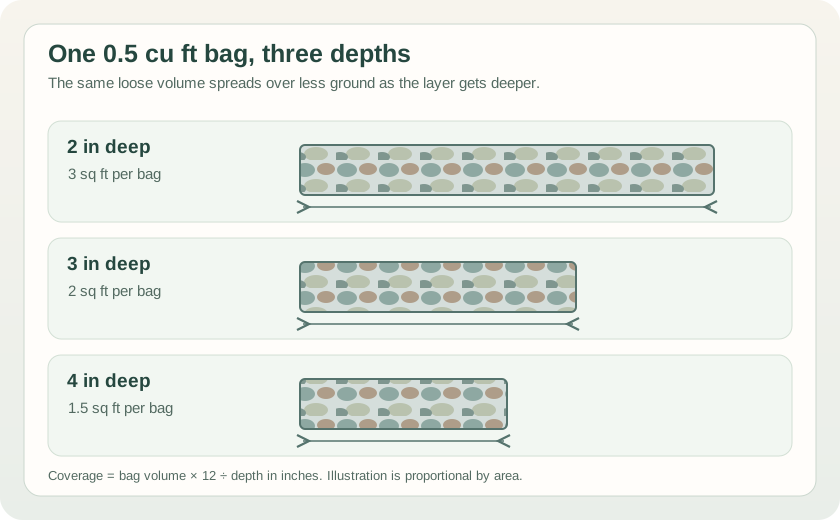
Depth changes the shopping list
Choose a finished layer before buying bags
For a decorative inorganic mulch, Utah State University Extension suggests 2–3 inches. Treat that as a starting point, not a promise that every stone size will hide the ground at the same depth. Spread a small sample at the intended depth; larger mixed river stones can leave visible gaps and rounded stones move more readily on slopes and walked paths.
| Installed depth | One bag covers | Bags for 100 sq ft |
|---|---|---|
| 2 in | 3 sq ft | 34 |
| 3 in | 2 sq ft | 50 |
| 4 in | 1.5 sq ft | 67 |
The 4-inch row illustrates how the math changes for a deeper layer; it is not a blanket recommendation. The bag count rounds up to whole bags. Add extra only after calculating installed volume.
From estimate to pickup
Three checks that prevent a second trip
Measure the area the stones touch
For a rectangle, multiply length by average width. For curves, split the bed into simple sections, add their areas, then use “I know the square feet.” Exclude large planters or paving that will stay uncovered.
Match the product and the quote
Compare bag and bulk costs for a similar size and color of river rock. Bulk may have a minimum billable order and a delivery fee. The calculator uses your entered prices; it does not assume a universal break-even point.
Plan the weight before pickup
Multiply whole bags by the weight on your chosen product. Check the “occupants and cargo” limit on the vehicle's doorjamb label, then account for people and other cargo. NHTSA shows where to find the tire and loading label.
For a larger bed, use the river rock calculator to compare yards and tons. If you are choosing between store bags and delivery, read the bulk versus bagged guide. River rock around plants can heat the soil and does not improve it; University of Minnesota Extension recommends considering that tradeoff.
River rock bag questions
How many bags of river rock cover a 10 × 10 ft bed?
At 3 inches deep, the bed needs 25 cubic feet of installed stone. Divide by 0.5 cubic feet per bag and round up: 50 bags without extra, or 55 bags with a 10% ordering allowance. Change the bag-volume field if your product is a different size.
How much area does one 0.5 cubic foot bag cover?
By volume, one 0.5 cubic foot bag covers 3 square feet at 2 inches deep, 2 square feet at 3 inches, or 1.5 square feet at 4 inches. Actual appearance depends on the stone size, shape, and how evenly it is spread.
How many half-cubic-foot bags equal one cubic yard?
One cubic yard contains 27 cubic feet, so it has the same loose volume as 54 bags labeled 0.5 cubic feet. This is a volume conversion, not a promise that 54 bags weigh the same as a supplier’s cubic yard of a different product.
Can I calculate bags from a 40, 44, or 50 lb label?
Use the package’s cubic-foot volume or stated coverage for the bag count. Pounds describe weight, not a fixed volume: river rock products labeled 0.5 cubic feet can have different listed weights. Enter the labeled weight only to estimate hauling load.
When is loose bulk river rock cheaper than bags?
There is no universal bag-count cutoff. Compare your rounded-up bag purchase with a quote for the same stone, including the supplier’s minimum order and delivery charge. Bags may be easier to place in a narrow yard even when their material cost is higher.