Count the rock surface, then protect the living bed
A flower bed is rarely a perfect rectangle. Break curved borders into short sections, measure an average width for each, and add their areas. Subtract sizable spaces you will leave uncovered. Keep stems and plant crowns visible when you spread the stone.
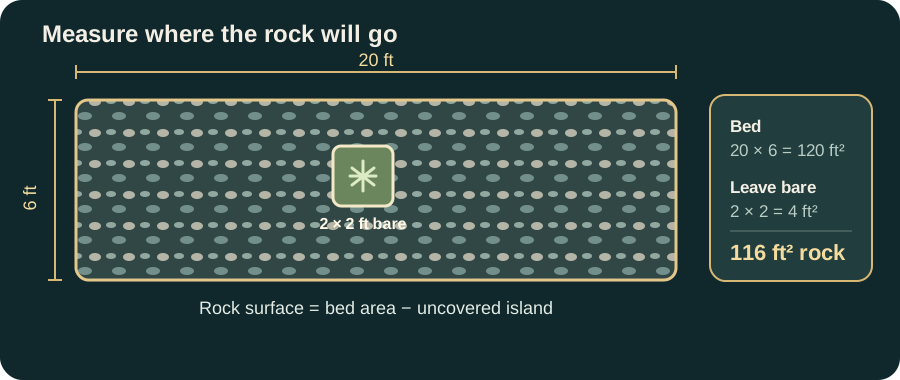
Worked example: a bed with an uncovered planting island
- Net area: (20 × 6) − (2 × 2) = 116 sq ft.
- Installed volume at 2.5 in: 116 × 2.5 ÷ 12 = 24.17 ft³ = 0.90 yd³.
- With no added allowance: an example 2,700 lb/yd³ river pebble is about 1.21 US short tons, or 49 whole 0.5-ft³ bags.
If you need a site allowance, apply it to the measured volume before converting to supplier units. A yard that sells in half-yard steps may round the final order differently.
Choose the surface for the plants, not just the color
Where stone fits
Small gravel can work as mulch in some dry landscapes, supporting water infiltration and reducing evaporation. Larger cobbles are chiefly a visual surface: their open gaps can expose soil and catch leaf litter. Choose a stone size that fits both the plants and future maintenance.
Where organic mulch may fit better
In densely planted or frequently replanted beds, bark or wood chips are easier to move and add organic matter as they break down. Colorado State University Extension notes that gravel can warm soil beneath it, while wood chips insulate against temperature swings. The useful choice depends on plant, climate, and stone size.
Planting guidance: Colorado State University Extension's mulching guide and Penn State Extension planting ornamentals guidance.
Depth and weight are separate decisions
Choose a finished depth that hides the soil to your eye without burying plants. Stone size, contrast with the soil, and expected movement all affect that choice; no one depth is correct for every garden. Depth sets cubic yards. Product weight changes only the estimated tons, so replace the example weight when your supplier gives one.
| Material example | Planning depth | Example loose weight | Check before ordering |
|---|---|---|---|
| Rounded river pebble | 3 in | 2,700 lb/yd³ | Local size, color, and weight |
| Pea gravel | 2 in | 2,700 lb/yd³ | Movement at bed edges |
| Lava rock | 2.5 in | 1,500 lb/yd³ | Product size and fragile pieces |
Weight examples come from Hello Gravel's separate river rock and pea gravel listings, plus Kentucky Lawn Care's one-yard lava rock listing. They are product examples, not standard densities.
Fabric, irrigation, and future maintenance
Prepare the planting soil
Finish soil amendments and irrigation layout before covering the bed. Fabric guidance differs by planting context: CSU discourages weed fabric under mulch in planted landscapes; if you use a permeable separator, check water and air access and leave room to maintain plants. Avoid solid plastic over roots.
Leave breathing room
Pull stone back a few inches from trunks and stems; keep crowns exposed. Check irrigation reaches the soil below the rock, especially in sunny beds where stone can add heat.
Plan to remove debris
Fabric can separate soil and rock, but it cannot stop all future weeds: dust, leaves, and seed collect among stones. Clear debris before it forms a rooting layer, and expect some hand weeding.
See CSU Extension on mulch and barriers, Utah State University Extension on permeable fabric, Oregon State University Extension on stem clearance, and Penn State Extension on weeds above fabric.
Buying bags or ordering bulk
The bag result uses volume, then rounds up; the tons result uses the editable supplier weight. They are two ways to buy the same planned volume, not quantities to add together. For a small top-up, check the package's cubic feet. A Vigoro river-pebble bag lists 0.5 ft³ and 50 lb, but other rock bags can differ. For a larger bed, compare the complete delivered bulk quote with bags, including delivery, loading, and your ability to place the material.
Garden rock questions
How much garden rock do I need for a 240 square foot bed?
At a measured 3-inch layer, 240 square feet needs 60 cubic feet, or 2.22 cubic yards, before any site allowance. At an example supplier weight of 2,700 pounds per cubic yard, that is about 3.00 US short tons. A labeled 0.5-cubic-foot bag would take 120 bags. Change the depth, supplier weight, and bag volume to match your project.
Should I subtract planting holes from the rock area?
Subtract large areas that will remain completely bare, such as a planting island, large planter, path, or patio inset. Small openings around individual stems often make little difference to a bulk order, but leave the finished rock pulled back from every crown and trunk.
Is fabric required under rock in a flower bed?
No single fabric detail suits every bed. Permeable landscape fabric can separate stone from soil and suppress some existing weeds, but windblown soil and seeds can still collect above it. It also complicates adding plants. Avoid impermeable plastic over roots and decide based on the bed, soil, and future planting plan.
Is garden rock better than wood mulch around plants?
Small gravel can help water soak in and reduce evaporation in some dry landscapes; larger decorative stone mainly changes the appearance of a bed. Rock can transfer heat into soil, while wood chips insulate and add organic matter as they break down. Match the cover to plant needs, climate, and maintenance, then keep either material away from stems.
Can I estimate bags from the weight printed on a bag?
Use the labeled cubic-foot volume for coverage. A 50-pound bag does not establish a universal volume because rock type and packing vary. If only weight is given, ask the seller for bag yield or volume before using a bag count.