Bulk volume planner

Pea Gravel Cubic Yard Calculator

A 20 × 12 ft area at 2 inches deep takes 1.48 cubic yards of pea gravel for the measured layer, or 1.63 cubic yards with 10% extra for low spots and handling. Enter your dimensions to plan a supplier order.

Material:Rounded pea gravel
Unit:1 cubic yard = 27 cubic feet
At 2 in:162 sq ft per cubic yard
Order by:Yards or supplier-quoted short tons
1.48 yd³
20 × 12 ft at 2 in
Measured layer volume before extra material
162 sq ft
One yard at 2 in
Geometric coverage before site allowance
27 ft³
One cubic yard
54 half-cubic-foot bags by volume

Measure your pea gravel layer

Defaults: 10% extra and 2,700 lb/yd³. Replace them with your site measurement and supplier quote. Rounding applies only if you select your seller’s yard increment.

Layer and order volumes

1.48
Measured layer (yd³)
240 sq ft × 2 in
1.63
Plan to order (yd³)
44 cu ft, plus 10% extra
1.63
At supplier increment (yd³)
No rounding selected
2.20
Approx. US short tons
Based on 2,700 lb/yd³

Weight uses the displayed order volume above. If your yard sells by weight, confirm its density and ton-order rules before buying.

Turn a measured layer into a yard order

A cubic yard is a volume, not a square-foot coverage promise. Measure the footprint first, choose the depth of the pea gravel itself, and keep a separate estimate for any compacted base. The calculator reports the layer volume, optional extra material, seller rounding, and an approximate weight.

Pea gravel yd³ = length (ft) × width (ft) × layer depth (in) ÷ 324

The divisor comes from 12 inches per foot × 27 cubic feet per cubic yard. For an irregular bed, split the footprint into rectangles, calculate each part, and add their yardages. For a circular area or several shapes, use the main pea gravel calculator.
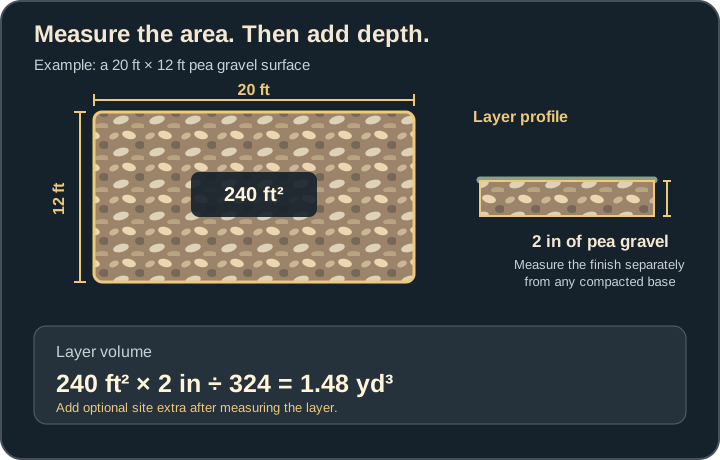
Diagram showing a 20 by 12 foot pea gravel footprint, a 2 inch layer, and the formula 20 times 12 times 2 divided by 324 equals 1.48 cubic yards
Use the depth of the pea gravel layer, measured after grading the ground or base. On a narrow screen, scroll the diagram sideways to read its labels.

One cubic yard: coverage at different depths

These are geometric yields from 27 cubic feet per yard. They exclude optional extra material, supplier rounding, and variations in the grade beneath the stone.

Pea gravel depthArea from 1 yd³For every 100 sq ft
1½ in216 sq ft0.46 yd³
2 in162 sq ft0.62 yd³
2½ inAbout 130 sq ft0.77 yd³
3 in108 sq ft0.93 yd³
4 in81 sq ft1.23 yd³

For another depth: coverage in sq ft = 324 ÷ depth in inches. If you already have a yardage and need the area it will cover, use the pea gravel coverage calculator.

Example: 20 × 12 ft with a 2 inch surface

  1. 1
    Measure the layer: 20 × 12 = 240 square feet. At 2 inches, 240 × 2 ÷ 324 = 1.48 yd³.
  2. 2
    Add only the extra you need: a chosen 10% for low spots, uneven edges, and handling brings the estimate to 1.63 yd³. This is not a fixed compaction percentage.
  3. 3
    Match the seller’s unit: quarter-yard increments mean ordering 1.75 yd³; half-yard increments mean 2 yd³. With no rounding, 1.63 yd³ at the example 2,700 lb/yd³ weighs about 2.20 short tons.

Sky Nursery lists half-yard pickup increments and whole-yard delivery increments, while Sutherland sells quarter-yard quantities. Your seller may use different steps, minimums, or delivery rules, so check before rounding.

Choose the right depth and surface

Two inches is a useful starting measurement for a small garden path or decorative surface, not a universal specification. A University of California garden pathway guide calls two inches a practical minimum and notes that rounded pea gravel shifts rather than packing into a solid surface. Edging helps contain it; furniture and frequent walking may call for larger stepping stones or an angular surface.

This calculator measures only the pea gravel finish. If your patio also needs a compacted base, measure that layer separately in the pea gravel patio calculator. For different uses and depths, see the rock depth guide.

What to confirm before ordering bulk pea gravel

  • Product: ask for the stone size and a sample. “Pea gravel” is a retail description; colors, grading, and roundedness differ by source.
  • Weight: ask for pounds per loose cubic yard if buying by short ton. Sky Nursery lists 2,500–2,700 lb/yd³ for its pea gravel, while Sutherland lists 2,540 lb/yd³ for another product. The tool’s 2,700 lb/yd³ is an editable planning value.
  • Sales unit: confirm the smallest yard increment, delivery minimum, and whether the quote is by cubic yard or scale weight. The displayed tons use the selected increment volume.
  • Delivery: confirm where the truck can safely dump and whether your vehicle can carry the quoted weight if collecting it. For a small order, compare bag counts with a bulk delivery.

Frequently Asked Questions About Pea Gravel Yardage

How many cubic yards of pea gravel do I need for a 15 × 15 ft area?

At 2 inches deep, 225 square feet needs 1.39 cubic yards for the measured layer. If you choose 10% extra for low spots and handling, the estimate becomes 1.53 cubic yards. A supplier selling only half-yard increments would round that to 2 cubic yards.

How do you calculate cubic yards of pea gravel?

For a rectangle, multiply length in feet by width in feet by the desired layer depth in inches, then divide by 324. This is the same as converting inches to feet and cubic feet to cubic yards. Add any site allowance after calculating the layer volume.

How much area does one cubic yard of pea gravel cover?

Before any ordering allowance, one cubic yard covers 216 square feet at 1½ inches, 162 square feet at 2 inches, 108 square feet at 3 inches, or 81 square feet at 4 inches. Divide 324 by the depth in inches for another depth.

How many tons is a cubic yard of pea gravel?

There is no fixed conversion. A planning value of 2,700 pounds per cubic yard equals 1.35 US short tons, but suppliers list different weights for their pea gravel. Use the density on your seller’s quote when ordering by weight.

Is the extra percentage a compaction factor?

No. Rounded pea gravel does not compact into a firm, interlocking layer. The optional extra percentage covers uncertain depth, low spots, handling, and edges. Set it to zero if your measured volume already accounts for those conditions.

Quarry Knowledge Network

Complete Landscape Aggregate Calculator Library

Explore material calculators, unit conversions, and practical field guides by project.

Material Calculators (20)

Core Landscape Rocks
Specialty and Base Aggregates

Conversion Calculators (28)

Generic Volume and Weight
Material Specific Conversions

River Rock Coverage Calculator

Coverage Solver

Convert river rock tons, yards, or bags to area at your depth and supplier bulk weight.

Gravel Tons Calculator

Tons Solver

Estimate US short tons with a supplier-specific loose bulk density.

Gravel Cubic Yards Calculator

Yards Solver

Measure finished gravel volume and plan a rounded bulk-yard order.

Gravel Bag Calculator

Bag Solver

Count bags by labeled volume and compare current bag and bulk quotes.

Crushed Stone Tons Calculator

Tons

Estimate short tons from depth and editable supplier bulk weight.

Crushed Stone Yardage Calculator

Yards

Round cubic yards to a supplier increment and plan delivery capacity.

Crushed Stone Bag Calculator

Bags

Count whole bags using the product label and compare local quotes.

River Rock Tons Calculator

Tons Solver

Estimate US short tons from measured area, depth, and editable supplier bulk weight.

River Rock Cubic Yard Calculator

Yards Solver

Separate installed yards from extra and round a bulk order to the supplier increment.

River Rock Bag Calculator

Bag Solver

Count bags from their labeled volume and compare current bag and bulk quotes.

Pea Gravel Patio Calculator

Patio Solver

Estimate separate pea gravel and base layers with editable depths and planning assumptions.

Pea Gravel Tons Calculator

Tons Solver

Estimate US short tons for a measured pea gravel layer with editable loose bulk density.

Pea Gravel Cubic Yard Calculator

Yards Solver

Separate measured layer volume from optional extra cubic yards for a bulk order.

Pea Gravel Bag Calculator

Bag Solver

Count retail pea gravel bags using the volume printed on your chosen bag.

Pea Gravel Coverage Calculator

Coverage Solver

Convert pea gravel tons, yards, or bags to area, or estimate an order from area and depth.

Decomposed Granite Tons Calculator

Tons Solver

Convert finished DG layer volume to loose order yards and short tons with editable assumptions.

Decomposed Granite Coverage Calculator

Coverage Solver

Estimate finished DG area per loose cubic yard or short ton at a chosen depth.

Lava Rock Bag Calculator

Bag Solver

Count whole landscape-lava bags from the label volume and estimate carrying weight.

Lava Rock Coverage Calculator

Coverage Solver

Convert known lava-rock yards, tons, or bags to area at a chosen depth.

Marble Chips Bag Calculator

Bag Solver

Count whole white marble chip bags from the volume printed on the chosen product.