Area → volume → weight
Keep the measured layer and the order allowance separate
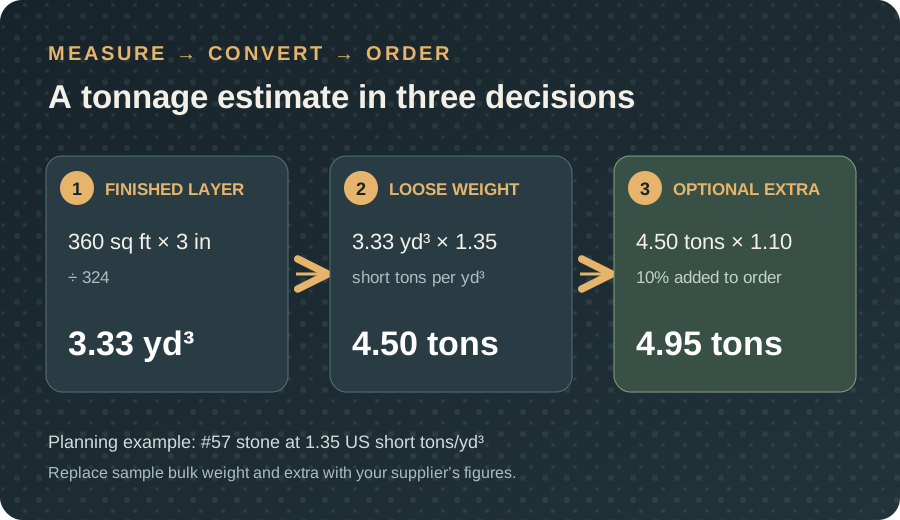
Length times width gives square feet. Multiplying by finished depth gives volume; only then does the stone’s loose bulk weight turn cubic yards into short tons. Bulk weight includes air between stones, so it is different from the density of a solid piece of limestone or granite.
cubic yards = area (sq ft) × depth (in) ÷ 324order tons = cubic yards × (1 + extra ÷ 100) × loose tons/yd³For the 30 × 12 ft example, 360 × 3 ÷ 324 = 3.33 yd³ in place. At 1.35 short tons/yd³, that is 4.50 tons before extra. A chosen 10% allowance raises the order estimate to 3.67 yd³ or 4.95 tons.
The divisor 324 combines 12 inches per foot with 27 cubic feet per cubic yard. The calculator keeps full precision internally, then rounds the displayed result.
Choose the material before the multiplier
Clean #57 and crusher run answer different needs
For a drainage layer, ask for clean, low-fines stone in the specified gradation. For a base meant to compact, ask about a dense-graded blend with fines. The quarry’s names can be regional, and a size number alone does not specify a material’s bulk weight.
Coarser particles leave connected spaces for water. The 1.35-ton/yd³ default is a planning weight for the tool, not a standard assigned by ASTM.
Check #57 size and uses →Smaller particles and fines fill many voids. Our material calculator uses 1.45 tons/yd³ as an editable starting weight for this separate product.
Estimate crusher run →ASTM D448 classifies aggregate size designations for roads and bridges. It does not make every quarry’s #57 a single weight. ASTM C29/C29M describes how bulk density and voids are measured; it also distinguishes dry test results from moist stockpiles and hauled loads.
Depth changes the yield
How far will one ton go?
The same ton covers half as much area when depth doubles. This reference assumes a flat layer of the sample #57 stone at 1.35 short tons/yd³, before any extra. It is useful for checking a takeoff; it does not prescribe a suitable construction depth.
| Finished depth | One cubic yard covers | One short ton covers |
|---|---|---|
| 2 in | 162 sq ft | 120 sq ft |
| 3 in | 108 sq ft | 80 sq ft |
| 4 in | 81 sq ft | 60 sq ft |
| 6 in | 54 sq ft | 40 sq ft |
A trench, driveway, and permeable pavement may each call for different stone and layer designs. Oregon State University Extension, for example, describes washed uniform aggregate and project-specific depths for porous pavement. Follow the project specification or local installer’s design rather than treating a calculator default as a construction rule.
Before and after the truck arrives
Match the quote and scale ticket to your estimate
Supplier listings show why the weight field stays editable: Ottr Supply’s #57 granite lists roughly 2,700 lb/yd³, while Hello Gravel’s #57 listing uses roughly 2,800 lb/yd³. For the same 360 sq ft example at 3 inches with 10% extra, those inputs produce 4.95 versus 5.13 short tons. They are examples from different suppliers, not a universal range.
- Confirm the grade and loose weight. Tell the yard whether you need clean stone or material with fines. Ask what weight it uses to convert yards to tons.
- Confirm the sales unit. A US short ton is 2,000 lb. If the quote is in metric tonnes, convert the unit before comparing prices or quantities.
- Ask about delivery. The usable payload depends on the actual truck and route. Ask the hauler how many tons can be delivered to your site and where the pile can be tipped.
- Read the ticket. If sold by weight, compare the material and net load weight with the quote. Gross minus tare gives net; a photo of a conical pile cannot establish its tonnage. Iowa DOT’s aggregate scale guidance identifies these ticket fields.
Ordering by cubic yard? Use the crushed stone yardage calculator. Buying retail bags for a small repair? Use the crushed stone bag calculator. For a broader comparison of stone grades, return to the crushed stone calculator.
Crushed stone tonnage questions
How many tons of crushed stone do I need for a 12 × 30 ft driveway?
At 3 inches of finished depth, 360 square feet requires 3.33 cubic yards in place. At the sample #57 loose bulk weight of 1.35 US short tons per cubic yard, that is 4.50 tons before extra. Adding an optional 10% order allowance gives 4.95 tons. Confirm the layer depth and supplier weight for your job.
How do I convert crushed stone cubic yards to tons?
Multiply cubic yards by the loose bulk weight of the exact stone in US short tons per cubic yard. Three cubic yards at 1.35 short tons per yard is an estimated 4.05 short tons. A short ton is 2,000 pounds; a metric tonne is a different unit.
How much area does one ton of #57 stone cover?
At the 1.35 short tons per cubic yard planning weight, one ton covers about 120 square feet at 2 inches deep, 80 square feet at 3 inches, or 60 square feet at 4 inches. These are level-layer estimates before any order allowance. Your quarry’s stone may have a different bulk weight.
Is #57 stone the same as crusher run?
#57 names a coarse aggregate size designation commonly sold as clean stone for drainage. Crusher run is a dense blend of crushed stone and fines used where a compacted base is specified. Product names and gradations vary by supplier; ask for the grading sheet when the choice matters.
Does the calculator tell me the certified scale weight?
No. It estimates an order from measured volume and an assumed loose bulk weight. The delivery scale ticket records the actual net weight. Check its material description and whether the quoted tons are US short tons or metric tonnes.