What the result means
A 30 × 5 ft border is 150 sq ft. A 2 in finished layer takes 25 cu ft (150 × 2 ÷ 12), or 0.93 cu yd (25 ÷ 27). A 10% ordering allowance brings that to 27.5 cu ft = 1.02 cu yd. At 2,700 lb per loose cubic yard, the order weighs about 2,750 lb = 1.38 US short tons. If you instead buy 0.5 cu ft bags, 27.5 ÷ 0.5 = 55 bags.
Use the bag calculator when a store sells 0.4 cu ft bags or quotes bag weight and price. Bag count depends on labeled volume; bulk density is used only for the loose stone tonnage estimate.
Choose depth before you buy
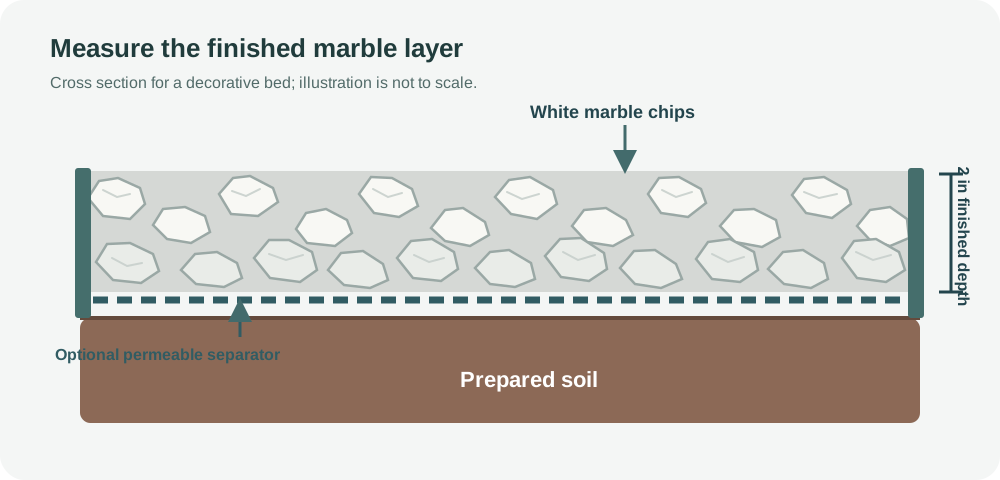
Coverage changes directly with finished depth. Choose a depth suited to the chip size, ground beneath, and the look you want; a top-up over existing rock is different from a new bed. The table shows pure volume math. The supplier used for the default weight advertises about 100 sq ft per cubic yard at 2 inches, versus 162 sq ft by geometry. Ask your seller to explain its product-specific yield and use the verified figure when placing the order.
| Finished depth | Coverage per cu yd | Coverage per US short ton at 2,700 lb/yd³ |
|---|---|---|
| 1.5 in | 216 sq ft | 160 sq ft |
| 2 in | 162 sq ft | 120 sq ft |
| 3 in | 108 sq ft | 80 sq ft |
Why bulk weight is editable
White marble products differ by source and chip grading. Cummin Landscape Supply lists about 2,700 lb per cubic yard for its marble chips, while Gravelshop lists 2,410 lb per cubic yard for its 1 in white chips. Both are supplier examples. Ask the seller for the loose bulk weight of the stone being delivered and replace the default when estimating tons.
Marble is a recrystallized carbonate rock that can contain calcite, dolomite, or both, as described by the US Geological Survey. Its particle density is different from the loose bulk weight used here because a stockpile contains gaps between chips. ASTM C29/C29M describes a method for measuring aggregate bulk density; this calculator uses supplier figures and does not claim a laboratory test of this particular stone.
Where white marble works, and where to pause
Good uses
Use it as a bright contrast in contained borders, around pavers, or in low-traffic accent beds. Install an edge so loose chips stay out of turf and off paving. Keep a small sample beside your exterior finish before committing to a large area; white chips can show leaves, dust, and stains readily.
Plant and maintenance checks
Carbonate stone can increase soil alkalinity through leaching. Mississippi State Extension advises against gravel or stone mulch near acid-loving plants and notes heat and reflected light. Keep chips away from stems and trunks, remove leaf litter, and plan for occasional hand weeding even if you use permeable fabric.
Fabric can separate stone from soil, but Oregon State Extension notes that weeds can grow in material above fabric. For planted tree rings, consider whether stone is appropriate for the plant before following a decorative layout.
Marble chips questions
How much marble do I need for 150 square feet at 2 inches deep?
The finished layer is 25 cubic feet, or 0.93 cubic yard. With 10% extra, plan 27.5 cubic feet or 1.02 cubic yards. At the editable example weight of 2,700 pounds per cubic yard, that is about 1.38 US short tons. It also equals 55 half-cubic-foot bags.
How many square feet does one cubic yard of marble chips cover?
One cubic yard covers 216 square feet at 1.5 inches, 162 square feet at 2 inches, or 108 square feet at 3 inches, before allowance. This is volume math; chip size and the surface below can change the finished appearance.
Will marble chips change soil pH?
Marble contains carbonate minerals. Leaching can increase soil alkalinity, so marble chips are a poor choice next to acid-loving plants. Consider the existing soil and planting plan before using them in a bed.
Do marble chips need landscape fabric?
A permeable separator can help keep stone and soil apart in a stable bed, but it is optional and does not permanently stop weeds. Leaf litter and windblown soil can collect above fabric, so the surface still needs maintenance.