Start here
Follow the water before buying more gravel
After the next safe rain, look for the first place runoff reaches the gravel and the point where it leaves. A rill down the middle calls for surface drainage; stone sliding under tires calls for a better base or confinement. If the soil is soft, repair that layer before topping it with fresh rock.
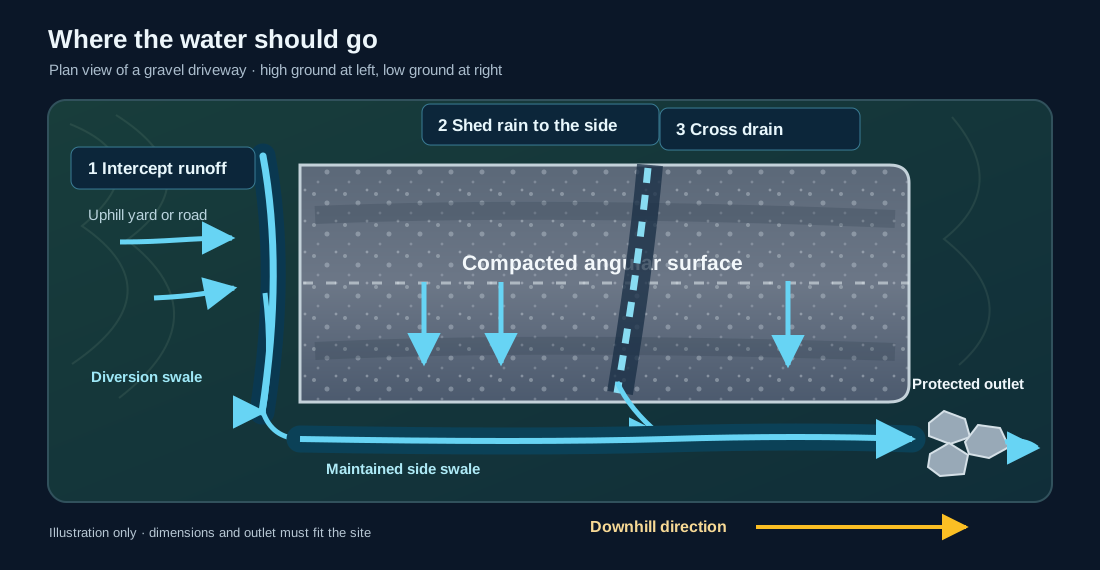
- Intercept runoff entering from uphill.
- Shed water across the surface before it forms a channel.
- Stabilize the stone and its discharge point.
01 / Diagnosis
What is actually moving the gravel?
Take photos during a storm from a safe location. Where the first rill starts matters more than the final pile of stone at the bottom.
| What you see | Likely problem | First move |
|---|---|---|
| Rills or a channel down the drive | Runoff is traveling along the surface. | Find its entry point; reshape the surface and plan a cross drain with an outlet. |
| Stone piles at the bottom, little sign of flowing water | Loose, rounded stone or traffic is shifting it. | Check the aggregate, compacted base, tire paths and edging. |
| Mud squeezes into wheel ruts | The subgrade is weak or remains wet. | Address drainage and rebuild the soft section; consider a separation geotextile. |
| Washout starts at the road or uphill yard | Outside runoff enters the driveway. | Intercept it before resurfacing; ask the road authority before changing a roadside ditch or culvert. |
| Soil erodes where a drain ends | The outlet is concentrated and unprotected. | Spread or armor the discharge after confirming where it can legally and safely drain. |
The FHWA gravel roads guide connects surface shape, aggregate quality and drainage to road performance. The EPA dirt and gravel roads manual describes intercepting upslope runoff with diversion swales.
02 / Site notes
Measure the grade and the water path
Grade describes how fast the ground falls; it does not by itself tell you which grid, rock size or drain will work. Rainfall, soil, traffic, slope length and the outlet also matter.
Calculate slope percentage
Grade (%) = vertical drop ÷ horizontal run × 100
For example, a 1 ft drop over a 20 ft horizontal run is a 5% grade. Use a level, string or laser to measure the drop. For an order estimate, measure the actual surface length of the sloped area.
Record these before choosing a fix
- Where roof, yard, road and ditch water enters
- Where surface water can leave without eroding soil
- Length of uninterrupted downhill flow
- Whether cars, pedestrians or only landscaping use the area
- Whether ruts reveal soft ground or moving surface stone
03 / Fixes that work together
Match each treatment to the failure
Most persistent washouts need a drainage change plus a stable surface. Choose the parts that address what you observed; the order below follows the path of the water.
Catch incoming surface runoff uphill
A shallow diversion swale or berm can keep yard runoff from crossing the gravel. It must carry water to a stable place where it can spread or drain. Keep water away from foundations and do not redirect concentrated flow onto a neighbor or into a public drain without approval.
Use a French drain when water is seeping through the ground, rather than assuming a buried pipe will capture a visible sheet of fast-moving surface water. A drain needs a suitable filter, pipe layout where used, maintenance access and a real outlet. If a subsurface trench is appropriate, the drain rock calculator estimates trench stone from its dimensions and pipe choice.
Give a driveway cross fall and a way out
Reshape a traveled gravel surface so rain runs toward a maintained side swale instead of following wheel ruts downhill. Depending on the site, that may be a crown or a one-sided cross slope. The side swale needs an outlet too.
On a longer run, a properly shaped, driveable rolling dip or designed cross drain can turn water off the road before it gains volume. A flush timber laid across a drive may trap gravel, but it does not automatically drain water and can create a driving hazard. Drain spacing and profile depend on local flow, soil and vehicle clearance. The US Forest Service surface cross-drain guide distinguishes driveable dips from waterbars commonly used on roads closed to traffic.
Use aggregate that fits the surface
For a vehicle surface, ask a local quarry for a well-graded, angular surface gravel with a suitable blend of coarse particles and fines, then compact it in lifts to the intended profile. Local names include crusher run, dense-graded aggregate and road base; the actual gradation matters more than the trade name. Clean #57 stone is useful in drainage work but has little fine material to bind a traveled surface.
Loose pea gravel and rounded river rock tend to move under tires and feet on a slope. On a decorative bed or path with little runoff, angular stone and solid edging may be enough. On a driveway, edging only contains lateral scatter; it cannot replace surface drainage. Compare angular and rounded rock before choosing the finish.
Add confinement where stone still migrates
A gravel grid or geocell can confine infill on a sloped path or driveway, but select a product rated for the intended traffic and slope. Prepare and drain the base first; follow that product's requirements for cell depth, infill, anchorage and edge restraint. A grid over a wet, rutting base will not correct the water problem.
Use a separation geotextile where soft soil is mixing into the aggregate, specified for the soil and load; ordinary weed barrier is not automatically a road fabric. Geocell manufacturers such as Presto Geosystems publish installation and anchoring instructions for their systems.
Protect the outlet, not just the gravel bed
Where a ditch, culvert or cross drain discharges, a stable vegetated spreader or properly sized rock apron can prevent a new gully. Riprap is for an eroding bank, channel or outlet; it is not a normal driving surface. Stone size, thickness, filter layer and apron dimensions depend on flow and site conditions, so avoid choosing a universal “Class 1” size from a label alone.
After the outlet detail is selected, the riprap calculator estimates volume and weight from area, thickness and an allowance. If the water threatens a building, public road, culvert or neighboring property, have a local drainage professional assess the discharge.
04 / Work plan
A practical repair sequence
- Map the storm path. Mark inflow, rills, low points and outlets; locate buried utilities before digging.
- Set the drainage route. Intercept outside runoff and provide cross fall or a cross drain that leads to a stable discharge area.
- Remove failed material. Excavate soft or mud-mixed sections rather than burying mud beneath new stone.
- Rebuild and compact the base. Use the local aggregate specification for the load; add separation fabric only where the subgrade needs it.
- Contain and finish the surface. Use a rated grid or edging if migration remains a problem after the drainage and base are sound.
- Inspect after rain. Clear blocked swales and cross drains, repair the first small rill, and check the outlet for scour.
05 / Ordering
Estimate stone after you choose the section
Measure the finished dimensions of each layer separately. A calculator estimates material quantity; it cannot size a ditch, culvert, grid anchor or riprap apron for storm flow.
Example: a 40 × 10 ft gravel surface
At a 3 in. finished layer depth: 40 × 10 × 3 ÷ 324 = 3.70 cubic yards in place. The order amount may be higher if the chosen material needs compaction or the excavated area is irregular. Ask the supplier for its actual gradation and loose bulk density, and avoid adding the same allowance twice.
Common decisions
Questions to settle before a repair
Will bigger gravel stop a driveway from washing out?
Not if runoff continues down the tire tracks. Larger stone may resist movement but can leave a rough, unstable surface and will not fix a weak base or missing outlet. Address the water path first, then choose the surface gradation.
Should I install a French drain across the driveway?
A buried drain is suited to seepage or a designed collection system, but exposed surface flow needs an inlet and a sized, maintainable outlet. A silted trench or pipe can worsen washout. For visible runoff, assess surface shaping, a swale or a traffic-rated cross drain first.
Does landscape fabric keep gravel on a slope?
Fabric can separate aggregate from soft soil when specified for that job. It does not hold the surface stone in place or redirect water, and weed-control fabric should not be assumed to carry driveway loads.
When should I get a site-specific design?
Get local help when washout repeatedly reaches a road or building, a culvert is involved, the slope shows cracks or slumping, or you cannot identify a stable and permitted discharge point. A high-flow outlet or steep vehicle access needs more than a generic grade rule.
Continue the site plan
Use the material guides after drainage and subgrade conditions are clear.
Field references
These references inform the drainage and aggregate principles above; they do not replace a design for an individual property.