Start with a shovel, not another load of rock
Is the rock sinking, being buried, or washing away?
Pull back roughly one square foot of the problem area. Look at the underside of the stone, the soil surface, and what happens after rain. These clues change the repair.
Mud comes up through the rock
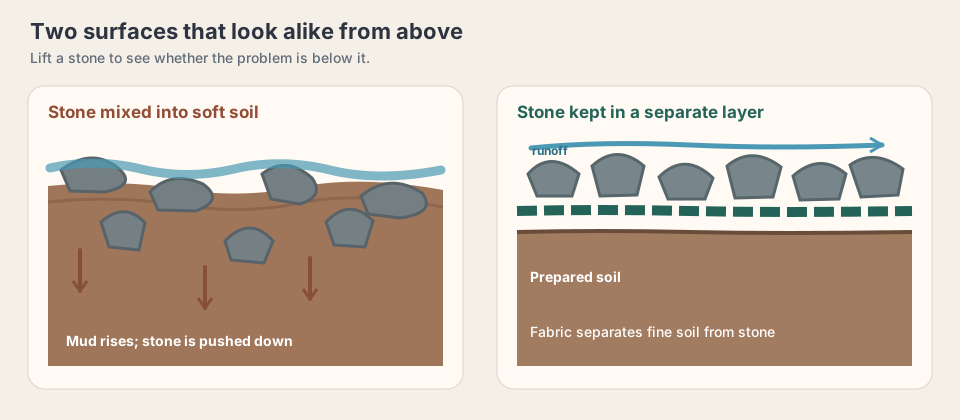
Soft soil and stone are mixing, especially under feet or tires. Remove contaminated material, correct persistent wetness, and rebuild over a suitable separation layer.
Stone is still there under dirt
Leaf litter, mulch, and windblown soil can cover a firm rock bed. Clean or sift reusable stone and keep new debris from collecting. Fabric underneath cannot stop buildup on top.
Stone collects downhill
Runoff or traffic is moving the surface. Redirect water, contain the edge, and choose stone that suits the slope. See the gravel washout guide for slope repairs.
Check the water first: A downspout, a low spot, or a blocked edge can keep the ground wet. Give runoff a lawful, stable route away from the house before covering the problem with stone.
For decorative beds and footpaths
Rebuild the rock where soil and stone are mixing
Recover usable stone
Rake or shovel it onto a tarp. If soil has filled the gaps, screen small batches and reuse the clean rock. Remove leaves, roots, and loose muddy material from the work area.
Prepare a firm, draining surface
Correct the source of standing water. Shape the exposed soil so water does not run toward the foundation or collect in the bed. Let saturated soil dry enough to work, then firm it without creating a bowl that traps water.
Separate only where it solves the problem
Where fine soil repeatedly enters the stone, lay a permeable geotextile intended for separation on smooth prepared soil. Follow its product guidance for overlaps, fastening, and cover. Thin weed-barrier film is not a substitute for a traffic-rated separator. Around plants you expect to divide or move, consider whether a buried sheet will complicate future work.
Replace stone to your chosen finished depth
Spread the cleaned rock evenly and add only the amount needed to restore the surface. Keep soil and mulch from spilling over the edge. For a walking path, use a compactable angular base where needed before the visible stone; loose rounded pebbles alone make an unstable walking surface.
If large edging stones appear to sink while the surrounding bed rises, dig one out and compare soil levels. Decomposed mulch and deposited soil may be burying it; clean and reset the edge instead of rebuilding the whole bed.
For wheel loads and recurring ruts
A muddy driveway needs drainage and a sound base
Repeatedly topping up a rut can waste stone when tires are pressing aggregate into wet fine soil or pumping mud into the base. First restore a surface shape that sheds water and an outlet that can carry it away. Then excavate the soft pocket or failing section to a firm working surface. A contractor can size the base for the soil, traffic, and climate; there is no universal three-inch fix for every muddy driveway.
Typical rebuild sequence
- Remove loose, mud-contaminated aggregate and soft organic material.
- Repair the water path and prepare the subgrade without churning wet soil into more mud.
- Where specified, place road-grade separation geotextile; add geogrid only when the base design calls for reinforcement.
- Place suitable angular aggregate in compacted lifts, then finish the surface so water can leave it.
A spring, persistent ponding, or ruts that return after a base rebuild deserve a site assessment. A perforated drain helps only when it has the right location, filter detail, and permitted outlet.
Make the layers match the job
What belongs beneath the visible rock?
| Area | Useful layer or action | What it will not solve |
|---|---|---|
| Decorative bed | Clean the stone and correct runoff; use a permeable separator if soil keeps mixing into it. | Leaves and dust accumulating above the stone. |
| Walking path | Firm subgrade, suitable separator where needed, and a compactable base below the finish stone. | A soft path caused by standing water or a buried organic layer. |
| Driveway | Drainage, road-grade separator where needed, and an aggregate base sized for vehicle loads. | Ongoing pumping if the subgrade and water source remain untreated. |
| Very weak ground | Site-specific stabilization, sometimes geogrid with a separate filtration layer. | Waterlogged soil with nowhere for water to go. |
Don't buy fabric from an ounce-per-square-yard number alone. For a loaded base, the supplier or designer should check separation and filtration needs, survivability during placement, and the aggregate placed above it. FHWA guidance distinguishes these functions from reinforcement.
Order after the repair depth is decided
Estimate the stone to put back
Measure the repaired length × width and the finished depth of each layer. For a rectangular area, cubic yards = length (ft) × width (ft) × depth (in) ÷ 324. Reused clean rock reduces the amount you need to buy.
These tools estimate material volume. They cannot diagnose the soil, size a road base, or determine a drain outlet.