River rock bulk order estimator

River Rock Tons Calculator

A 30 × 10 ft bed at 3 in deep takes 3.75 US short tons at the 1.35 tons-per-yard planning weight. Add 10% extra and the order estimate becomes 4.13 tons. Enter your own depth and supplier weight below.

Material:Rounded river rock
Order unit:US short ton (2,000 lb)
Weight:Editable loose bulk density

Estimate a bulk order

How many tons of river rock do you need?

Measure only the surface receiving stone, then enter the depth of the finished layer. The tonnage is an estimate until your supplier confirms the loose weight of its river rock.

How have you measured the area?

Depth: enter the layer you will install, not the size printed on the rock bin. A single layer of large cobbles may need a supplier coverage figure instead.

Weight: 1.35 is a starting estimate, equal to 2,700 lb per cubic yard. Replace it with the loose bulk weight for the product in your quote.

Extra: optional material for low spots and handling. It increases both order yards and order tons; it does not change the planned finished depth.

Estimated amount to order

4.13US short tons

300 sq ft at 3 in depth, with 10% extra

Rock at finished depth
3.75 tons
Order volume
3.06 yd³
Installed volume before extra
2.78 yd³
Estimated order weight
8,250 lb
One ton covers at this depth
80 sq ft

Coverage per ton is for a level layer before extra. Ask the yard whether it sells this grade by scale weight or measured volume and how it converts between them.

The conversion

From a measured layer to a tonnage estimate

Square footage and finished depth give you volume. The seller’s loose bulk weight converts that volume to short tons. This weight includes the air spaces between stones; it is different from the density of an individual rock.

cubic yards = area (sq ft) × depth (in) ÷ 324short tons = cubic yards × loose short tons per yd³

For the starting example: 300 × 3 ÷ 324 = 2.78 yd³. At 1.35 tons/yd³, the layer weighs about 3.75 tons. Multiplying by 1.10 for the chosen 10% extra gives 3.06 yd³, or 4.13 tons to order.

The 324 divisor combines 12 inches per foot and 27 cubic feet per cubic yard. The 1.35 multiplier is an editable planning assumption, not a guaranteed product weight.
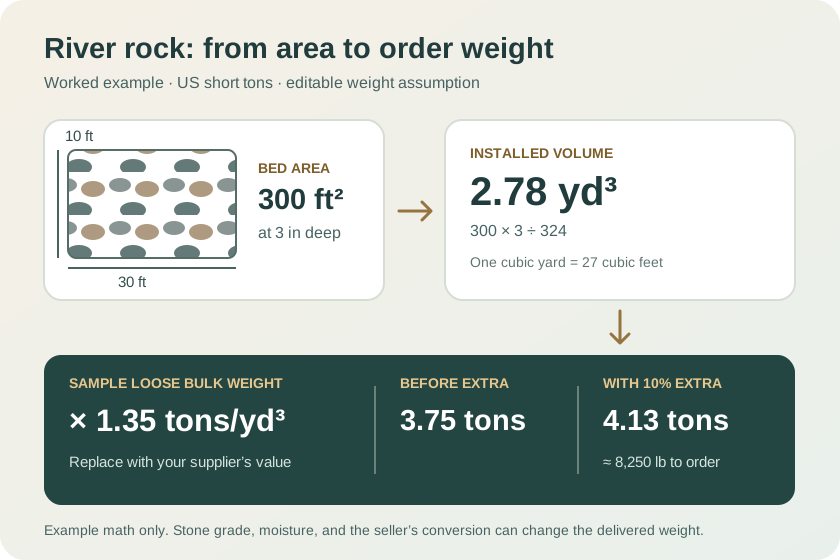
River rock conversion diagram: 300 square feet at 3 inches equals 2.78 cubic yards; at 1.35 short tons per cubic yard this is 3.75 tons before extra, or 4.13 tons with 10 percent extra.
Swipe to read the diagram. Keep volume, material weight, and order allowance as separate steps.

The depth decision

One ton covers less ground as the layer gets deeper

These yields assume 1.35 US short tons per cubic yard, a flat layer, and no extra allowance. They are conversion examples, not promises about the appearance of a particular stone size. A mixed 1–3 in river rock often starts around a 3 in planning depth; inspect the actual grade before committing to a full order.

River rock area covered before ordering extra
Installed depthOne cubic yard coversOne short ton covers
2 in162 sq ft120 sq ft
3 in108 sq ft80 sq ft
4 in81 sq ft60 sq ft
6 in54 sq ft40 sq ft
For large cobbles: “6–10 inch rock” names a size range, not a 6–10 inch layer. A single visible course has an uneven surface and gaps, so a blanket-depth estimate can mislead. Ask for coverage of that specific grade per ton or lay out a small sample, measure its area, and scale from the amount used.

If the project is a dry creek, measure the stone-lined bottom and banks by section. This tool estimates quantity; it does not size rock for flowing water. See the dry creek bed guide for that separate design question.

Before paying for a load

Check the weight attached to the seller’s stone

Supplier listings illustrate why the weight field is editable: Rocky Top Resources uses an approximate 1.30-ton-per-cubic-yard rock conversion on its 1–2 in gray river rock listing, while Kent Countryside lists about 1.40 tons per cubic yard for 3/8 in river rock. This calculator starts at 1.35; use the figure for the stone you actually select.

1.30 tons/yd³3.97 tons
1.35 tons/yd³4.13 tons
1.40 tons/yd³4.28 tons

Each comparison uses the same 300 sq ft bed, 3 in installed depth, and 10% extra. Only the assumed loose bulk weight changes.

  • Confirm the exact grade. “River rock” can include widely different size mixes and amounts of fines; ask to see a sample.
  • Confirm the unit. A quote by the ton and a quote by the cubic yard need the seller’s tons-per-yard factor to compare.
  • Confirm delivery limits. Ask about the minimum order, available truck payload, delivery fee, and where the load may be tipped. Do not treat a generic truck-load figure as universal.
  • Keep moisture separate. ASTM C29/C29M describes bulk density testing for aggregate up to 5 in nominal maximum size; it does not assign river rock a universal 1.35 value. Stockpile moisture and placement can make a delivery differ from a dry test value.

Need volume or bag quantities instead? Use the river rock cubic yard calculator or river rock bag calculator. To work backward from a known tonnage to square feet, use the river rock coverage calculator.

River rock tonnage questions

How many tons of river rock do I need for 300 square feet?

At 3 inches deep, 300 square feet needs 2.78 cubic yards before extra. At the 1.35 short tons per cubic yard planning weight, that is 3.75 short tons. With 10% extra, the order estimate is 3.06 cubic yards or 4.13 short tons. Replace the planning weight with your supplier’s value when possible.

How do I turn cubic yards of river rock into tons?

Multiply cubic yards by the loose bulk weight in US short tons per cubic yard for the product you are buying. For example, 3 cubic yards at 1.35 short tons per cubic yard is an estimated 4.05 short tons. A short ton is 2,000 pounds.

How much area does one ton of river rock cover?

At the calculator’s 1.35 short tons per cubic yard planning value, one short ton covers about 120 square feet at 2 inches deep, 80 square feet at 3 inches, or 60 square feet at 4 inches. This is level-layer coverage before any ordering allowance.

Is a 6-inch river rock a 6-inch-deep layer?

A stone-size label describes the rocks, not the layer thickness. Large mixed cobbles placed in one visible layer do not form a uniform blanket, so a depth-based tonnage is only a rough estimate. Ask the stone yard about coverage for that exact grade or lay out a measured sample area.

Does the extra allowance cover wet rock?

The extra percentage adds order volume for low spots, uneven spreading, and handling loss. It does not predict how much a wet load will weigh. Ask the seller how its tons-per-yard conversion and scale weight are determined.

Quarry Knowledge Network

Complete Landscape Aggregate Calculator Library

Explore material calculators, unit conversions, and practical field guides by project.

Material Calculators (20)

Core Landscape Rocks
Specialty and Base Aggregates

Conversion Calculators (28)

Generic Volume and Weight
Material Specific Conversions

River Rock Coverage Calculator

Coverage Solver

Convert river rock tons, yards, or bags to area at your depth and supplier bulk weight.

Gravel Tons Calculator

Tons Solver

Estimate US short tons with a supplier-specific loose bulk density.

Gravel Cubic Yards Calculator

Yards Solver

Measure finished gravel volume and plan a rounded bulk-yard order.

Gravel Bag Calculator

Bag Solver

Count bags by labeled volume and compare current bag and bulk quotes.

Crushed Stone Tons Calculator

Tons

Estimate short tons from depth and editable supplier bulk weight.

Crushed Stone Yardage Calculator

Yards

Round cubic yards to a supplier increment and plan delivery capacity.

Crushed Stone Bag Calculator

Bags

Count whole bags using the product label and compare local quotes.

River Rock Tons Calculator

Tons Solver

Estimate US short tons from measured area, depth, and editable supplier bulk weight.

River Rock Cubic Yard Calculator

Yards Solver

Separate installed yards from extra and round a bulk order to the supplier increment.

River Rock Bag Calculator

Bag Solver

Count bags from their labeled volume and compare current bag and bulk quotes.

Pea Gravel Patio Calculator

Patio Solver

Estimate separate pea gravel and base layers with editable depths and planning assumptions.

Pea Gravel Tons Calculator

Tons Solver

Estimate US short tons for a measured pea gravel layer with editable loose bulk density.

Pea Gravel Cubic Yard Calculator

Yards Solver

Separate measured layer volume from optional extra cubic yards for a bulk order.

Pea Gravel Bag Calculator

Bag Solver

Count retail pea gravel bags using the volume printed on your chosen bag.

Pea Gravel Coverage Calculator

Coverage Solver

Convert pea gravel tons, yards, or bags to area, or estimate an order from area and depth.

Decomposed Granite Tons Calculator

Tons Solver

Convert finished DG layer volume to loose order yards and short tons with editable assumptions.

Decomposed Granite Coverage Calculator

Coverage Solver

Estimate finished DG area per loose cubic yard or short ton at a chosen depth.

Lava Rock Bag Calculator

Bag Solver

Count whole landscape-lava bags from the label volume and estimate carrying weight.

Lava Rock Coverage Calculator

Coverage Solver

Convert known lava-rock yards, tons, or bags to area at a chosen depth.

Marble Chips Bag Calculator

Bag Solver

Count whole white marble chip bags from the volume printed on the chosen product.