From measured depth to a tonnage order
The calculator estimates the loose bulk quantity for the finished pea gravel surface. It first converts the rectangular layer to cubic yards, then applies bulk density. The optional extra allowance is added once, at the end. A compacted crushed-stone base needs its own estimate.
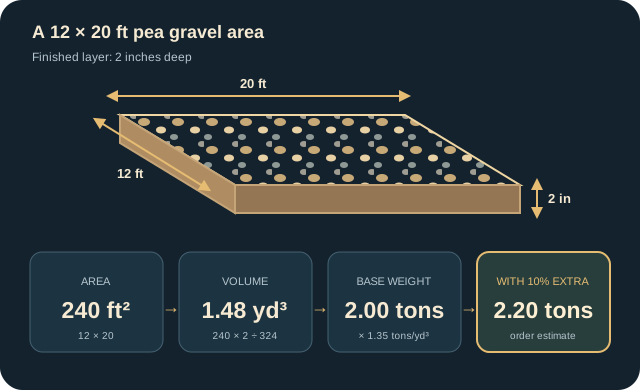
Cubic yards = length (ft) × width (ft) × depth (in) ÷ 324US short tons = cubic yards × short tons per cubic yard × (1 + extra % ÷ 100)For a 12 × 20 ft area at 2 inches, the layer is 1.48 yd³ before extra. At 1.35 short tons/yd³, that is 2.00 tons; with 10% extra, the order estimate is 2.20 short tons (about 4,400 lb). The calculator opens with this example so you can change one assumption at a time.
How much area does a ton of pea gravel cover?
These are geometric yields for a level layer using 1.35 US short tons per cubic yard. They exclude the extra allowance and change when you enter a different density. A deeper layer uses more stone for the same area.
| Finished depth | Square feet per short ton | Short tons for 100 sq ft |
|---|---|---|
| 1.5 in | 160 sq ft | 0.63 ton |
| 2 in | 120 sq ft | 0.83 ton |
| 2.5 in | 96 sq ft | 1.04 tons |
| 3 in | 80 sq ft | 1.25 tons |
At 2 inches, a useful field check is area ÷ 120 ≈ tons before extra. For paths and seating areas, choose depth based on the prepared surface and how the space will be used. Utah State University's water-wise landscaping guide describes a 3-inch gravel layer over landscape fabric as an acceptable walkway. Rounded pea gravel still shifts underfoot, so a firm base and edging matter; see the depth guide and rounded versus angular stone guide before increasing depth just to make a path feel firmer.
Which pea gravel density should you enter?
The default 1.35 short tons/yd³ equals 2,700 lb/yd³ and keeps this estimator aligned with the site's main pea gravel calculator. It is a starting point, not a property of every product. For example, South Bay Materials lists 2,440 lb/yd³ for its 3/8-inch pea gravel (enter 1.22), while Smokey Point lists 2,720 lb/yd³ for its washed 3/8-inch pea gravel (enter 1.36). Those are product examples, not universal limits.
If the supplier quotes pounds per cubic yard, divide by 2,000 to get US short tons per cubic yard. A 1.35 to 1.22 change lowers the tonnage estimate by about 10% even though cubic yards stay the same. For a larger order, ask for the density or weight per cubic yard of the exact stone and whether the quote is by the short ton or by the cubic yard. See the density reference for other aggregates.
Take the estimate to the supplier
- Measure the finished layer. Use the inside edge of the border and measure depth from the prepared base to the planned top of the stone. Split irregular shapes into rectangles.
- Confirm the product and unit. “Pea gravel” can describe different rounded stones. Give the supplier the size, the estimated cubic yards and short tons, and ask which density applies to their product.
- Check the delivery quantity. Ask about the minimum order, available increments, and where a truck can tip the material. Round to the seller's increment only after you have the calculated tonnage.
- Keep other layers separate. An angular base, edging, or bags for a small repair are different purchases; use the bag calculator if a bulk load is more than you need.
Playground surface? A 2–3 inch landscape layer is not a playground fall surface. The CPSC home playground handbook calls for maintaining 9 inches of sand or pea gravel for equipment up to 5 feet high, with an initial 12-inch fill to allow settling. Public playground surfacing has separate impact-testing guidance in the CPSC public handbook. Set depth to the applicable design before estimating tons.
Pea gravel tons questions
How many tons of pea gravel do I need for a 12 × 20 foot area?
At 2 inches deep, 240 square feet needs 1.48 cubic yards, or 2.00 US short tons at the default 1.35 tons per cubic yard. Add the calculator’s 10% allowance and the estimate becomes 1.63 cubic yards or 2.20 tons. Check your supplier’s density before ordering.
How do you convert square feet of pea gravel to tons?
Multiply area in square feet by finished depth in inches, divide by 324 to get cubic yards, then multiply by the supplier’s short tons per cubic yard. Multiply once more by 1 plus your extra allowance as a decimal if you want to include one.
How many square feet does one ton of pea gravel cover?
At the 1.35 short tons per cubic yard planning value, one ton covers about 160 square feet at 1.5 inches, 120 at 2 inches, 96 at 2.5 inches, or 80 at 3 inches. These are level-layer yields before any extra allowance.
What does a cubic yard of pea gravel weigh?
This calculator starts at 2,700 pounds, or 1.35 US short tons, per cubic yard. Actual supplier listings differ: examples include 2,440 and 2,720 pounds per cubic yard. Use the weight for the specific product you plan to buy.
Should I include the crushed-stone base in my pea gravel tonnage?
No. This estimate is for the finished pea gravel layer only. Measure and order any compactable base aggregate separately because its thickness and bulk density differ.