The worked example
What a 100-square-foot result means
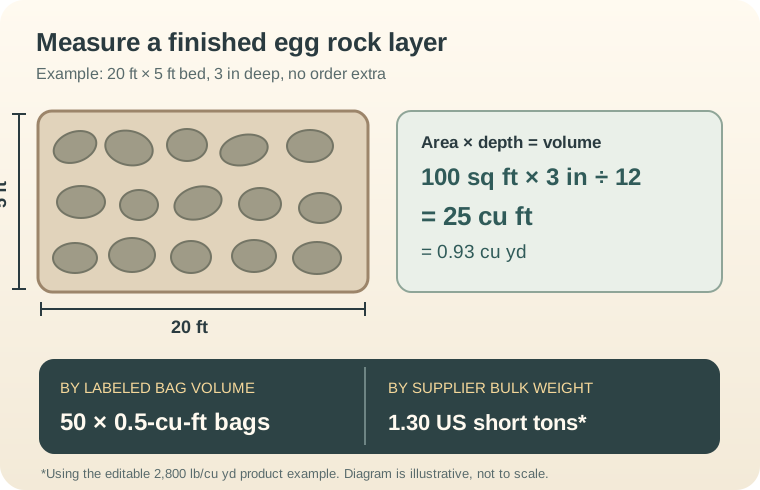
A 20 × 5 ft bed is 100 sq ft. At 3 in deep, the finished layer occupies 25 cu ft (100 × 3 ÷ 12), or 0.93 cu yd. With no optional extra, 25 ÷ 0.5 means 50 bags labeled half a cubic foot. At Main's example weight of 2,800 lb per cubic yard, 0.93 yard is about 2,593 lb, or 1.30 US short tons. Your supplier's weight changes the tons; it does not change the geometric volume.
Finished cu ft = area (sq ft) × depth (in) ÷ 12
Order cu yd = finished cu ft × (1 + optional extra ÷ 100) ÷ 27
US short tons = order cu yd × supplier lb/cu yd ÷ 2,000
Choose the stone before choosing its depth
“Egg rock” describes a rounded appearance, not a uniform national gradation. Main's lists a 1–3 in rounded grade, while a Lowe's bag lists stones larger than 3 in. Inspect a sample or product photo with a scale. Larger cobbles leave wider visible gaps at the same depth; a small test patch shows whether the soil or separator appears through the layer.
Contained accent bed
Rounded stone gives a soft edge around a dry creek or planting border. Measure only the area receiving stone, and check the grade against edging height and adjacent pavement.
Walking surface
Egg-sized, smooth pieces shift underfoot and do not lock together like angular aggregate. For a regularly used path or accessible route, evaluate a stable surface design instead of assuming a deeper egg rock layer will firm up.
Drainage feature
Visible stone can finish a swale or dry stream. A working drain also depends on slope, outlet, filter, and base design. The coverage tool sizes only the visible stone layer, not a French drain or structural base.
See how depth changes the order
One cubic yard is 27 cubic feet, so its geometric coverage is 324 divided by depth in inches. The examples below have no extra and use 0.5-cu-ft bags. They are volume equivalents, not promises of visual opacity or a supplier's delivered yield.
| Depth | Finished cu yd | Whole 0.5-cu-ft bags | Area per cu yd |
|---|---|---|---|
| 2 in | 0.62 | 34 | 162 sq ft |
| 3 in | 0.93 | 50 | 108 sq ft |
| 4 in | 1.23 | 67 | 81 sq ft |
A 3-in layer has 50% more volume than a 2-in layer on the same area. Main's product page also posts a 70-sq-ft coverage figure at 3 in without stating whether that is per ton or per yard; its rounded ton-to-yard shortcut differs slightly from its 2,800-lb/yd³ weight. The table above is volume math, so ask the seller what unit and field allowance its coverage figure uses. Confirm the grade in a sample patch. For a top-up, measure only the missing depth.
Match the result to the way your seller quotes
Bulk by cubic yard or ton
Cummin lists roughly 2,400 lb per cubic yard for its 1.5–2 in egg rock. Main's lists 2,800 lb for a 1–3 in grade. Enter the weight from the yard that will supply your stone. Loose stockpiles, grading, and moisture affect a weight conversion; ASTM C29/C29M is a method for measuring bulk density, not a universal egg rock weight.
Retail bags or bulk sacks
A retail egg rock listing specifies 0.5 cu ft and 50 lb, while another product is a 0.33-cu-yd, 900-lb bulk bag. Read the package volume before counting bags. Compare the complete local price including delivery or pickup, and ask about minimums and yard increments; a fixed bag-versus-bulk crossover will not hold for every seller.
Plan for the bed after installation
Keep the layer in place
Rounded pieces can migrate from a sloped or uncontained bed, especially toward a lawn or walk. Grade the surface and use an edge suited to the site. If runoff crosses the area, address its route rather than treating loose cobbles as the only erosion control.
Keep soil and plants in mind
Iowa State Extension notes that a separator under rock can keep it from mixing with soil, while windblown organic matter can support weeds above it. Fabric is a site choice, not a weed guarantee. Rock can warm a sunny bed and supplies no organic matter; keep stone off plant stems and tree trunks, and choose mulch that suits the plants.
Maintain the visible surface
Remove leaves and soil before they settle into gaps. If the bed contains plants, keep access for watering, weeding, and future changes. UF/IFAS advises limiting rock mulch around garden plants and points to dry creek beds and downspout areas as better uses in its climate.
Egg rock questions
How much egg rock do I need for 100 square feet?
At a 3-inch finished depth, 100 square feet needs 25 cubic feet, or 0.93 cubic yard, before extra. That is 50 bags labeled 0.5 cubic foot. At an example loose bulk weight of 2,800 pounds per cubic yard, the same volume is about 1.30 US short tons. Replace the weight and bag volume with your product details.
How many square feet does a ton of egg rock cover?
At 3 inches deep and an example weight of 2,800 pounds per cubic yard, one US short ton is about 0.71 cubic yard and covers about 77 square feet by volume. A supplier listing 2,400 pounds per cubic yard would yield about 90 square feet at the same depth. Actual visible coverage can change with size, voids, and the bed surface.
How many bags of egg rock are in a cubic yard?
One cubic yard is 27 cubic feet, so it takes 54 bags if each bag holds 0.5 cubic foot. Check the volume printed on the bag; a 50-pound label alone is not enough to calculate a reliable bag count across different stone products.
Is egg rock the same as river rock or Mexican beach pebble?
Egg rock usually describes rounded decorative stone, and sellers do not all use the name the same way. Some group Mexican beach pebbles under egg rock; others sell them separately. Check the actual size, finish, package volume, and supplier weight before substituting products.
Does egg rock need landscape fabric?
A permeable separator can help keep stone and soil apart in some beds. It is optional, and it will not make the surface weed-free: leaves and windblown soil can collect between the rocks. Consider the planting plan, soil, maintenance access, and local conditions before installing it.
Sources and scope
Product sizes, bag labels, and supplier weights above come from the linked sellers. For planting and maintenance, see Iowa State Extension, UC IPM, and UF/IFAS. Their climate and plant advice may differ. This tool estimates the volume of a decorative surface layer; confirm local product yield, site design, and delivered quantities with the supplier or installer.