Three measurements, one conversion
Turn a gravel layer into an order weight
Area and depth describe volume; a quarry sells a weight. First convert the planned layer to cubic yards. Then multiply by the gravel's loose bulk weight in short tons per cubic yard. Add your extra allowance once, after calculating the layer itself.
cubic yards = area (sq ft) × depth (in) ÷ 324short tons = cubic yards × loose short tons per yd³order tons = short tons × (1 + extra % ÷ 100)For a 10 × 50 ft area at 3 in, 500 × 3 ÷ 324 = 4.63 yd³. At 1.40 short tons/yd³, that is 6.48 tons at the planned depth. Choosing 10% extra raises the order estimate to 7.13 tons. One US short ton is 2,000 lb.
The divisor 324 combines 12 inches per foot with 27 cubic feet per cubic yard. If you already have cubic yards, enter them directly and the calculator skips the area and depth conversion.
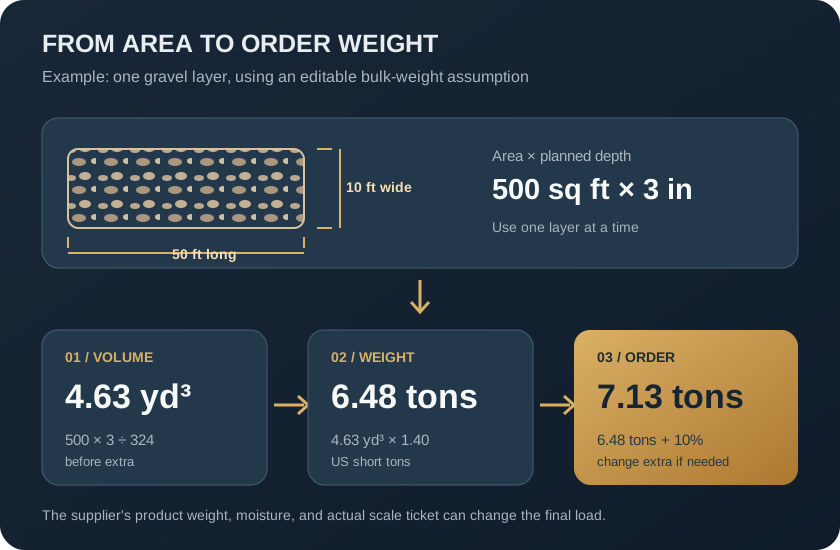
A check against the measured area
How far does one ton of gravel spread?
These figures use the same 1.40 short tons/yd³ planning weight and an even layer. They exclude extra. If the actual gravel weighs more per yard, a ton covers less ground. For your selected density, the calculator above updates the 3-inch yield.
| Layer depth | One cubic yard covers | One short ton covers |
|---|---|---|
| 2 in | 162 sq ft | 116 sq ft |
| 3 in | 108 sq ft | 77 sq ft |
| 4 in | 81 sq ft | 58 sq ft |
| 6 in | 54 sq ft | 39 sq ft |
This table estimates material quantity, not the depth a new driveway requires. Site conditions, traffic, subgrade, and the aggregate's role determine the section. See the depth guide and gravel size guide before treating a single number as a design.
For driveways and compacted bases
Count the base and surface as separate orders
A base with fines and a clean surface gravel are different products. Their depths and bulk weights may differ, and a compacted finished layer may need more loose material than its geometric volume suggests. Measure each layer, calculate its tons, and add the orders only after checking the supplier's values.
Measure the compacted target
Confirm the base aggregate and finished thickness with your plan or installer. Ask the supplier what loose quantity achieves that thickness after placement and compaction. Enter any additional order amount deliberately in the extra field.
Calculate the top layer
Run the calculator again with its own depth and bulk weight. A decorative rounded gravel or clean drainage stone should not inherit the base's density or allowance.
For example, on the same 500 sq ft area, a hypothetical 4-inch base at 1.50 tons/yd³ is 9.26 tons before extra; a separate 2-inch layer at 1.40 tons/yd³ is 4.32 tons. That is 13.58 tons before any product-specific allowances. These example depths are arithmetic inputs, not a driveway specification. For a fuller project estimate, use the driveway rock calculator; for a particular fractured stone, use the crushed stone tons calculator.
Before the truck is booked
Make the estimate match the yard's quote
The North Dakota Local Technical Assistance Program gravel spread chart uses 1.4 tons per cubic yard as an approximate conversion. Its separate spread chart assumes a 25% compaction factor; this calculator does not apply that factor. ASTM C29/C29M describes how to measure aggregate bulk density; it does not set a standard weight for all gravel. The standard also notes that moisture and packing in stockpiles or haul units can differ from a dry test.
All three figures use 500 sq ft, a 3-inch layer, and 10% extra. Only the bulk weight changes. The surrounding values illustrate sensitivity; they are not prescribed densities for specific gravel grades.
- Name the exact material. Ask whether the quote is for clean stone, natural gravel, or a graded base with fines. FHWA's granular-base guidance explains why grading and particle shape matter to a base layer.
- Get the conversion used on the quote. Ask for that product's approximate pounds or short tons per loose cubic yard. If the seller quotes cubic yards, compare those with your order volume.
- Clarify the finished depth. Confirm whether your planned number is loose spread depth or compacted depth. Ask what allowance is appropriate for that product and site.
- Plan delivery from the actual payload. Ask about the truck's legal load for your route, minimum order, delivery charge, and safe tipping spot. A single generic truckload figure cannot determine your number of trips.
Need a volume order instead? Use the gravel cubic yard calculator. For small retail quantities, use the gravel bag calculator. The rock density reference helps compare other aggregates.
Gravel tonnage questions
How many tons of gravel do I need for a 10 × 50 foot area?
At 3 inches deep, 500 square feet needs 4.63 cubic yards before extra. At the calculator’s 1.40 short tons per cubic yard planning value, that is 6.48 short tons. With 10% extra, the order estimate is 7.13 short tons. Use your supplier’s bulk weight and the depth for your actual layer.
How do I convert cubic yards of gravel to tons?
Multiply cubic yards by the loose bulk weight of your gravel in US short tons per cubic yard. For example, 5 cubic yards at 1.40 short tons per cubic yard is about 7 short tons. The conversion changes with the product and its condition.
How many square feet does one ton of gravel cover?
At an assumed 1.40 short tons per cubic yard, one short ton covers about 116 square feet at 2 inches, 77 square feet at 3 inches, or 58 square feet at 4 inches. These are level-layer estimates before an extra allowance.
Does the 10% extra automatically cover compaction?
No. The extra field is a chosen ordering allowance, not a measured compaction factor. If your plan specifies a compacted finished depth, ask the supplier or installer how much loose material that product needs to reach it. Calculate base and surface layers separately.
How many tons fit in a gravel delivery truck?
There is no reliable capacity for every truck. Legal payload, truck configuration, route, and access differ. Give the supplier your estimated tons and ask how many deliveries it will take, the minimum order, and where the load can be tipped.