Volume first
A cubic yard is a measured volume, not a fixed weight
One cubic yard contains 27 cubic feet. For a rectangular layer, multiply length by width in feet, then multiply by depth in inches and divide by 324. The divisor converts inches to feet and cubic feet to cubic yards.
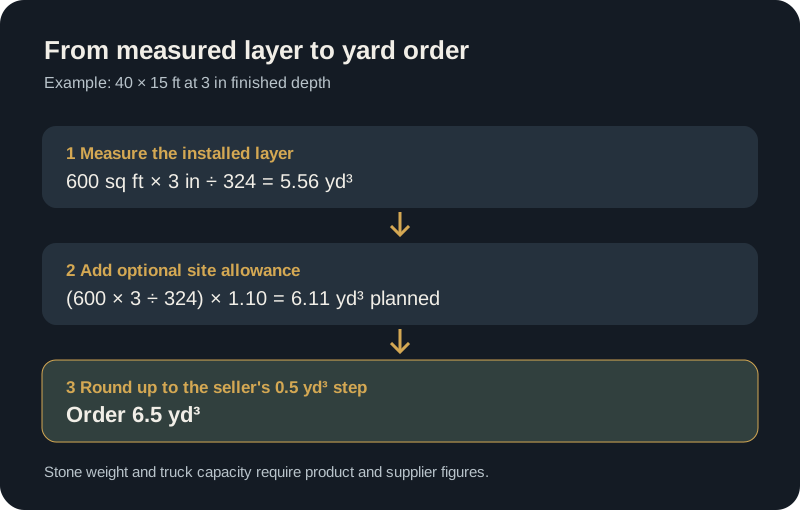
installed yd³ = area (sq ft) × depth (in) ÷ 324planned yd³ = installed yd³ × (1 + extra % ÷ 100)order yd³ = round planned yd³ up to seller's incrementFor 40 × 15 ft at 3 in, the installed layer is 600 × 3 ÷ 324 = 5.56 yd³. Applying 10% to the unrounded volume gives 6.11 yd³ when displayed. A seller taking half-yard orders would quote 6.5 yd³.
To convert the rounded order to weight, multiply 6.5 yd³ by the actual loose bulk tons per yard. At the sample 1.35 rate, the estimate is 8.78 US short tons. The quarry scale ticket records delivered weight.
Buying by the yard
Ask how your supplier rounds the order
At the same 6.11 yd³ planned amount, the step size changes what you actually buy. The step is a supplier term, not a physical property of crushed stone.
| Seller's increment | Order quantity | More than 6.11 yd³ plan |
|---|---|---|
| 0.25 yd³ | 6.25 yd³ | 0.14 yd³ |
| 0.5 yd³ | 6.5 yd³ | 0.39 yd³ |
| 1 yd³ | 7 yd³ | 0.89 yd³ |
For irregular areas, divide the project into rectangles and add the square footage before using the calculator. For a trench, use its actual length, width, and aggregate depth; subtract substantial pipe or structure volume if the supplier's takeoff calls for it. If the job has separate clean stone and compactable base layers, estimate and order each grade separately through the crushed stone material calculator.
Delivery constraints
A truck can run out of payload before bed space
A stone order has both volume and weight. The usable cubic yards per load are the smaller of the truck's bed-volume limit and its permitted stone payload ÷ short tons per cubic yard. For illustration, a 10-yd³ bed with a 12-ton stone payload at 1.35 tons/yd³ is weight-limited to 8.89 yd³ per trip. The example 6.5-yd³ order fits into one such load.
Many sellers quote this material by scale ton rather than cubic yard. Ottr Supply's #57 granite listing gives about 2,700 lb/yd³, while Hello Gravel lists about 2,800 lb/yd³ for its #57 product. They illustrate why one default cannot describe every quarry. ASTM C29/C29M provides a method to measure aggregate bulk density in loose or compacted condition; it does not assign a universal value or a truck capacity.
Want an order by weight instead? Use the crushed stone tons calculator. For retail packages, use the crushed stone bag calculator; delivery fees and access can change the better buying format. For a base with fines, check the crusher run calculator and ask for the local product's gradation.
Crushed stone yardage questions
How many cubic yards of crushed stone do I need for 600 square feet?
At a finished depth of 3 inches, 600 × 3 ÷ 324 = 5.56 cubic yards in the layer. With an optional 10% site allowance, plan for 6.11 yards before the supplier rounds the order. At a half-yard ordering increment, that becomes 6.5 cubic yards.
How many square feet does one cubic yard cover?
One cubic yard covers 162 square feet at 2 inches deep, 108 square feet at 3 inches, or 81 square feet at 4 inches, assuming an even finished layer and no extra allowance. Stone gradation does not change this geometric conversion.
How many cubic yards fit on a delivery truck?
Ask the supplier for both its bed-volume limit and permitted payload for your delivery. The usable yards per load are the smaller of bed capacity and payload in short tons divided by the quoted tons per cubic yard. Access and local restrictions may reduce the practical load further.
Are loose delivery yards the same as compacted base yards?
Not necessarily. The geometry gives volume at your chosen finished depth; dense-graded base may settle during compaction. Enter a loose-to-finished factor supplied for the actual product as the extra allowance if needed. Do not add a second blanket compaction factor to an estimate that already includes one.
Can I compare a quote by the ton with a quote by the cubic yard?
Yes. Multiply the yard quote by the seller’s loose short tons per cubic yard to estimate the scale weight, then compare full delivered totals including minimum charges and fees. The calculator’s 1.35 value is an editable planning example, not a guaranteed quarry weight.