First check at the shelf
Cubic feet set coverage; pounds set the load
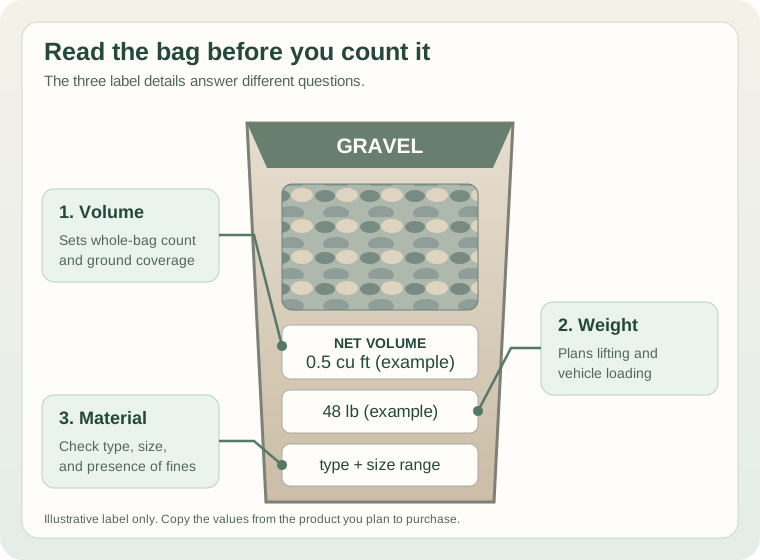
Find the bag's cubic-foot volume or a stated coverage area at a stated depth. That number tells you how many packages fill the space. The weight helps plan lifting and vehicle trips. A bag labeled only in pounds cannot give an exact square-foot yield without its volume or a product-specific bulk density.
Product listings show the difference. Vigoro all-purpose decorative stone lists 0.5 cu ft and 48 lb. A Sakrete pea gravel data sheet states that its 50 lb bag yields approximately 0.6 cu ft. Check the actual product rather than converting every 50 lb bag to 0.5 cu ft.
The examples are different products, not interchangeable gravel choices. ASTM C29/C29M is a method for measuring aggregate bulk density in loose or compacted condition; it does not supply one universal bag weight.
The calculation
Convert the finished layer to whole bags
Multiply the area by the finished depth in feet to get installed cubic feet. Apply any chosen extra before dividing by the labeled bag volume, then round up once. The rounded purchase may contain a little more gravel than the calculated layer.
installed cu ft = area (sq ft) × depth (in) ÷ 12whole bags = ⌈installed cu ft × (1 + extra % ÷ 100) ÷ cu ft per bag⌉For a 10 × 10 ft patch, the depth changes the purchase more than many shoppers expect. The table uses 0.5-cubic-foot bags and no added allowance. Actual packages may have another yield.
| Finished depth | Installed volume | Coverage per bag | Whole bags |
|---|---|---|---|
| 2 in | 16.67 cu ft | 3 sq ft | 34 |
| 3 in | 25 cu ft | 2 sq ft | 50 |
| 4 in | 33.33 cu ft | 1.5 sq ft | 67 |
One cubic yard is 27 cubic feet, so it equals 54 half-cubic-foot bags or 45 bags of 0.6 cubic foot by volume. Neither number specifies a pallet count. For an irregular area, split it into rectangles, subtract large uncovered spaces, and enter the sum using “Total square feet.”
Buy the right bag
“Gravel” on the shelf can mean different jobs
The bag count measures space, but the stone inside still has to suit the project. Check the size range, whether the pieces are rounded or angular, and whether the mix contains fines. A coverage estimate cannot turn a decorative bag into a compactable base or a washed drainage aggregate.
Clean angular stone
Check the grade and whether it is washed when you need open spaces for drainage. See the drain rock calculator for a drainage layer and crushed stone bags for small repairs.
Graded gravel with fines
A base mix includes small particles that fill voids when compacted. Choose the specified base material and account for its compacted yield; the crusher run calculator handles that planning.
Rounded pea gravel
Small smooth pieces give a different walking and edging feel from angular stone. Use the pea gravel bag calculator when that is the product you will buy.
The gravel size guide helps name the material before you ask a store or landscape yard for a matching quote. Follow the project specification and the chosen product's installation guidance for layer depth.
Before checkout
Turn the bag number into an order you can move
- 1
Compare equivalent material and volume
Multiply the rounded bag count by your local bag price. Ask the bulk yard for an all-in delivered quote that covers at least your planned cubic feet, with its minimum and unloading location. There is no universal “20 bag” price crossover; access and local charges decide. See bulk versus bagged rock for the wider tradeoff.
- 2
Check the vehicle's actual capacity
Use the product's labeled pounds per bag to calculate the total packaged load. Then read the occupants-and-cargo limit on your own vehicle's tire and loading placard, allowing for passengers and other cargo. NHTSA explains that placard; a car or pickup class name does not tell you how many gravel bags it can carry.
- 3
Keep layers and spaces separate
For a path or patio, calculate each material layer with its own specified finished depth and product yield. Don't count a crushed base and decorative surface as one bag type. Keep edging, fabric, and any delivery or placement labor outside the stone volume.
Common questions
Gravel bags, coverage, and buying
How many bags of gravel cover 100 square feet?
At 2 inches deep, 100 square feet needs 16.67 cubic feet. That is 34 whole bags if each bag contains 0.5 cubic foot, before extra. At 3 inches deep, the same area needs 50 such bags. Read your product’s volume label and change the calculator if its bag size differs.
How much does one bag of gravel cover?
A 0.5-cubic-foot bag covers 3 square feet at 2 inches deep, 2 square feet at 3 inches, or 1.5 square feet at 4 inches, by volume. Divide the cubic feet printed on another bag by your depth in feet to find its coverage.
Are all 50 lb gravel bags 0.5 cubic foot?
No. Weight alone does not establish volume. A Vigoro all-purpose decorative stone listing gives 0.5 cubic foot and 48 lb, while a Sakrete pea gravel data sheet gives approximately 0.6 cubic foot for a 50 lb bag. Use the cubic-foot yield or coverage stated for the specific product.
How many gravel bags are in a cubic yard?
One cubic yard is 27 cubic feet. It equals 54 bags only when each bag contains 0.5 cubic foot. For 0.6-cubic-foot bags, the same volume is 45 bags. This is a volume conversion, not a fixed number of pounds or a pallet count.
When should I switch from bagged gravel to bulk delivery?
There is no reliable bag-count cutoff. Multiply the rounded-up bag count by the local price, then compare it with a delivered bulk quote for enough of a comparable gravel, including minimums and fees. Consider where the material can be unloaded and how you will move it.