A yard and a ton cover different areas
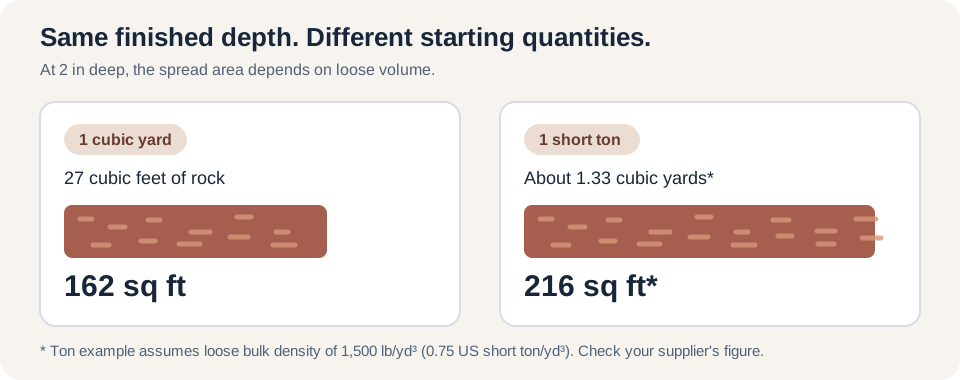
A cubic yard is a volume: 27 cubic feet regardless of the rock's weight. A short ton is a weight: 2,000 pounds. Converting a ton into coverage requires the loose bulk density for the specific lava rock.
From cubic yards: square feet = cubic yards × 324 ÷ depth in inches.
From short tons: cubic yards = short tons × 2,000 ÷ bulk density in lb/yd³.
From bags: square feet = bags × labeled ft³ per bag × 12 ÷ depth in inches.
Lava rock coverage by finished depth
These are geometric yields for an even layer. The short-ton column assumes 1,500 lb/yd³; change that factor in the calculator if your supplier provides a different number. The bag column assumes a label of 0.5 ft³.
| Depth | 1 cubic yard | 1 short ton* | 1 bag† |
|---|---|---|---|
| 1.5 in | 216 sq ft | 288 sq ft | 4 sq ft |
| 2 in | 162 sq ft | 216 sq ft | 3 sq ft |
| 3 in | 108 sq ft | 144 sq ft | 2 sq ft |
| 4 in | 81 sq ft | 108 sq ft | 1.5 sq ft |
* At 1,500 lb/yd³. † At 0.5 ft³ per bag. These yields exclude purchase allowance.
Worked example: a 300-square-foot bed
At a finished depth of 2 inches, the bed needs 50 cubic feet of lava rock. That is 1.85 cubic yards, about 1.39 short tons at the example density, or 100 half-cubic-foot bags before any allowance.
Choose an optional 10% extra purchase allowance and the order becomes 55 cubic feet, 2.04 cubic yards, about 1.53 short tons, or 110 half-cubic-foot bags. The bed is still 300 square feet; the allowance changes the quantity you buy.
For package-specific bag counts and cost, use the lava rock bag calculator. For a bed measured in length and width, use the lava rock calculator.
Check the product before you order
- Bulk weight varies. Palmer lists about 1,300–1,500 lb per cubic yard across its lava rock sizes; Sutherland lists 1,420 lb per cubic yard for one black lava product. Ask your yard for the figure used on your order.
- Bag volume matters more than bag weight for area. One retail red lava product is labeled 0.5 ft³ and 3 sq ft at 2 inches. Other products may use a different package size or weight.
- Choose a depth for the actual stone size and bed. A thinner layer spreads farther, but the intended appearance and weed management may call for a different depth. Keep rock away from trunks and follow local planting guidance.
- Read the intended-use label. Landscape lava rock is not automatically approved for a fire feature; the cited retail bag explicitly says it is not for fire pits.
Sources: Palmer lava rock specifications, Sutherland black lava product, Vigoro 0.5 ft³ red lava bag, and Utah State University Extension mulch guidance. Supplier figures describe those products, not all lava rock.
Lava rock coverage questions
How much area does one cubic yard of lava rock cover?
One cubic yard contains 27 cubic feet. Spread evenly, it covers 162 square feet at 2 inches, 108 square feet at 3 inches, or 81 square feet at 4 inches. These are volume-based figures, so the rock’s weight does not change them.
How much area does one short ton of lava rock cover?
At the example loose bulk density of 1,500 pounds per cubic yard, one 2,000-pound short ton is about 1.33 cubic yards and covers 216 square feet at 2 inches. Enter your supplier’s density for a product-specific estimate.
How much area does a 0.5 cubic foot bag cover?
A bag labeled 0.5 cubic foot covers 3 square feet at 2 inches or 2 square feet at 3 inches, before any allowance. Check the actual bag volume on the product label; bag weight is not a substitute for labeled volume.
Does the extra allowance change the coverage chart?
No. The chart shows geometric area at a finished depth. An optional allowance increases the quantity to buy for an area you enter; it does not make a cubic yard spread farther.