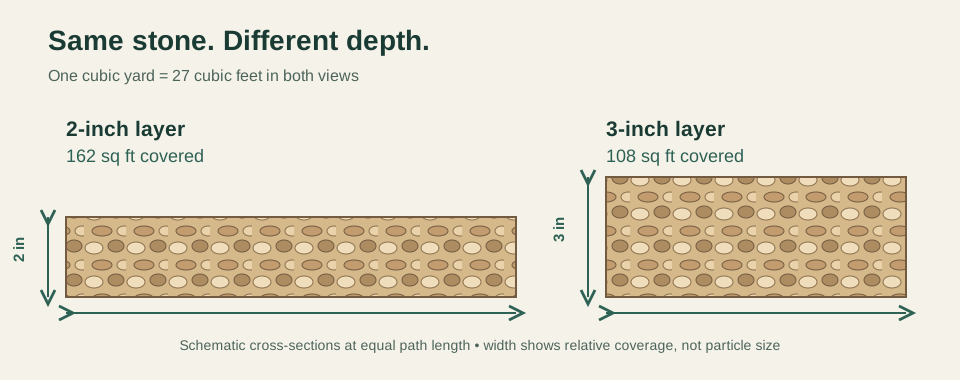
Pea gravel coverage by depth
A cubic yard always contains 27 cubic feet. Its area yield depends on how thickly you spread it. Tons require a weight assumption: this chart uses 1.35 US short tons per cubic yard, so a ton represents about 20 cubic feet. Bag figures use a labeled volume of 0.5 cubic foot. There is no order allowance in the chart.
| Finished depth | 1 cubic yard | 1 US short ton | 1 × 0.5 ft³ bag |
|---|---|---|---|
| 1 in | 324 sq ft | 240 sq ft | 6 sq ft |
| 1.5 in | 216 sq ft | 160 sq ft | 4 sq ft |
| 2 in | 162 sq ft | 120 sq ft | 3 sq ft |
| 2.5 in | 129.6 sq ft | 96 sq ft | 2.4 sq ft |
| 3 in | 108 sq ft | 80 sq ft | 2 sq ft |
| 4 in | 81 sq ft | 60 sq ft | 1.5 sq ft |
A shallow chart row is a conversion, not an installation recommendation. These are even-layer yields; plan for low spots and handling loss. A retailer may list a smaller practical bag yield than the pure volume conversion.
Keep the units straight
Why the conversion works
Convert the layer depth to feet, then divide available cubic feet by that depth. For one cubic yard at 2 inches: 27 ÷ (2 ÷ 12) = 162 square feet. For one US short ton with the default density: (27 ÷ 1.35) ÷ (2 ÷ 12) = 120 square feet.
To estimate an order, reverse the calculation: area (sq ft) × depth (in) ÷ 324 = cubic yards. Add a chosen allowance only after the measured volume. For 200 square feet at 2 inches, the measured volume is 1.23 cubic yards; a 10% allowance raises the order quantity to 1.36 cubic yards.
Pick the depth for the surface you are actually making
Cover soil; leave plant crowns clear
Use the chart to compare a 2- or 3-inch decorative layer, then adjust for stone size, existing grade, and planting gaps. Stone lasts but does not add organic matter and may warm the soil. Keep it away from stems and trunks.
Estimate other garden rock →Separate the topping from the base
Start your coverage estimate with a 2-inch pea gravel layer over a prepared base, then check a small section for your site. Rounded particles move underfoot; a deeper loose layer does not become firm by adding more stone. Edging helps contain it.
Compare rounded and angular stone →Check how the surface will be used
Chairs with narrow legs, carts, and wheels can sink or push the gravel aside. This calculator measures only the pea gravel surface; calculate a compacted base separately. Choose a firm surface where accessible travel is required.
Estimate a patio and base →Before you order or spread
- Measure the real footprint. Break curves and L-shapes into sections. Subtract paving, planters, and other areas that will not receive stone.
- Enter the finished pea gravel thickness. Do not include excavation depth or a crushed-stone base in this layer.
- Check the supplier’s units. A delivered cubic yard is volume; a US short ton is weight. The yard’s actual loose bulk weight controls ton coverage. A bag’s labeled cubic feet controls bag coverage.
- Set an allowance you can explain. The default 10% is an editable planning choice for uneven ground and handling, not a physical property of pea gravel. Set it to 0 for a pure conversion.
Pea gravel coverage questions
How many square feet does one ton of pea gravel cover?
At the calculator’s planning density of 1.35 US short tons per cubic yard, one ton covers about 160 square feet at 1.5 inches, 120 at 2 inches, 96 at 2.5 inches, or 80 at 3 inches. Your supplier’s loose bulk weight can change the ton figures.
How many square feet does one cubic yard cover?
One cubic yard holds 27 cubic feet. Spread evenly, it covers 162 square feet at 2 inches, about 130 at 2.5 inches, or 108 at 3 inches. The volume-based answer does not depend on stone density.
How much pea gravel do I need for 200 square feet?
At 2 inches, 200 square feet needs 33.33 cubic feet or 1.23 cubic yards before an allowance. With a chosen 10% order allowance, that becomes 36.67 cubic feet, 1.36 cubic yards, about 1.83 short tons at 1.35 tons per yard, or 74 bags labeled 0.5 cubic foot.
Will 50-pound bags cover the same area as 0.5-cubic-foot bags?
Only if those particular 50-pound bags are labeled 0.5 cubic foot. Bag weight and bag volume measure different things; enter the package volume in the calculator. A 0.5-cubic-foot bag mathematically covers 3 square feet at 2 inches before unevenness or handling loss; a product label may give a smaller practical yield.
Should I count a crushed-stone base in the pea gravel depth?
No. Enter only the finished pea gravel layer for this coverage estimate. A compacted angular base is a separate material and should be calculated separately with the pea gravel patio calculator or a crushed-stone calculator.
The 1.35-ton planning default is consistent with a supplier listing of 2,700 lb per cubic yard; another supplier lists 2,720 lb. A retail pea gravel product is labeled 0.5 cubic foot. For surface decisions, see UC Master Gardeners’ gravel path guidance, University of Minnesota Extension’s mulch guidance, and the U.S. Access Board’s guidance on firm, stable surfaces. These references inform the assumptions; your product label and site conditions govern your order.