The yardage calculation
Convert the finished space to cubic yards
A cubic yard is 27 cubic feet. Multiply area in square feet by finished depth in inches, then divide by 324. That divisor combines 12 inches per foot with 27 cubic feet per yard. Washington Rock Quarries uses the same volume-first approach for a real drain-rock top-up.
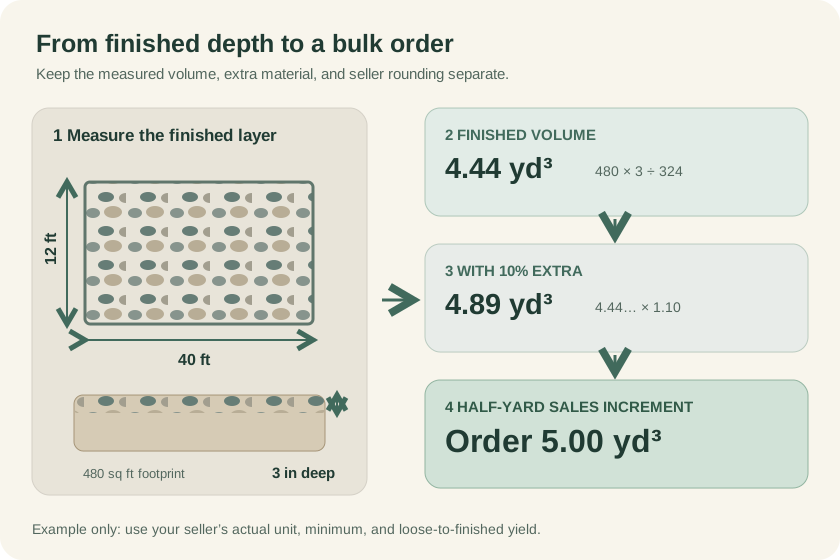
finished yd³ = area (ft²) × depth (in) ÷ 324yards with extra = finished yd³ × (1 + extra % ÷ 100)Worked example: A 40 × 12 ft area is 480 sq ft. At 3 in, it needs 480 × 3 ÷ 324 = 4.44 yd³ in place. Ten percent extra makes 4.89 yd³. If the supplier sells half yards, round up to 5.00 yd³. The exact yardage comes from geometry; the extra and sales increment are separate decisions.
Depth changes coverage
How far does one cubic yard of gravel spread?
At an even depth, 1 yd³ covers 324 ÷ depth in inches square feet. Choose depth for the material and job before using a coverage chart. A thin decorative refresh, a drainage layer, and a compacted driveway base have different requirements; a stone’s size label alone does not specify an installation depth.
| Finished depth | Area covered by 1 yd³ | Yards for 400 sq ft |
|---|---|---|
| 2 in | 162 sq ft | 2.47 yd³ |
| 3 in | 108 sq ft | 3.70 yd³ |
| 4 in | 81 sq ft | 4.94 yd³ |
| 6 in | 54 sq ft | 7.41 yd³ |
If a project uses a base and a surface layer, calculate each at its own depth and with its own product. The driveway rock calculator helps plan a driveway, while the drain rock calculator addresses drainage material.
The material matters after the volume calculation
Keep loose order volume, compacted yield, and weight distinct
Dense-graded base
Fines between angular stones help a base compact. Specify the finished compacted depth, then ask how many loose yards of that product are needed to achieve it. Washington Rock’s clean-versus-minus guide explains why the products behave differently.
Clean drainage gravel
Open-graded stone without fines serves a different job. Do not apply a dense-base compaction factor automatically. Measure the trench or bed volume, then confirm the selected grade and delivery unit with the seller.
Decorative or pea gravel
A surface layer is often planned by visible finished depth. If you are topping up existing gravel, measure only what is missing. For rounded material, use the pea gravel cubic yard calculator.
The tool’s 2,800 lb/yd³ default is a planning example, close to the 1.4-ton-per-yard figure used in one Washington Rock project example. It is not a certified weight for every gravel. ASTM C29/C29M is a method for measuring aggregate bulk density and voids, including loose and compacted conditions; it does not prescribe a universal 1.40-ton value. Moisture and stockpile conditions can also affect the weight of a delivered load.
Measure the space you will fill
Handle curves, ruts, and top-ups before ordering
- Map the footprint. Divide a curved path or tapered driveway into smaller rectangles. Add their square footage and use the tool’s “known square footage” setting.
- Measure the missing depth. Check several points. For a top-up, calculate only the new thickness needed above a sound existing layer, not the whole finished structure.
- Separate unequal depths. A deep rut or trench should have its own area × depth calculation; add its cubic yards to the surface layer instead of assuming the deepest point represents the whole site.
- Choose the extra deliberately. Set 0% to see the geometric volume, then add a site-specific amount for uneven grades, handling loss, or supplier-advised compacted yield.
Before placing the order
Give the supplier a quantity it can actually quote
Say what gravel product and gradation you want, your calculated yards, and whether the depth is loose or finished after compaction. Then ask:
- Is this product sold by cubic yard or US short ton, and what loose tons-per-yard figure should I use?
- What are the smallest order increment and delivery minimum? A calculator’s half-yard rounding is only an example.
- For a compacted base, what loose quantity will yield the specified finished depth?
- Can the truck reach the drop point, and where can the load be tipped safely?
If the quote is by weight, use the gravel tons calculator. For a broader material estimate, return to the gravel calculator.
Gravel cubic yard questions
How many cubic yards of gravel do I need for a 20 × 20 ft area?
A 20 × 20 ft area is 400 sq ft. At 3 in finished depth, it needs 3.70 cubic yards in place (400 × 3 ÷ 324). With a 10% allowance, the estimate is 4.07 cubic yards before any supplier rounding.
How many square feet does one cubic yard of gravel cover?
One cubic yard covers 162 sq ft at 2 in, 108 sq ft at 3 in, or 81 sq ft at 4 in, assuming an even layer. Divide 324 by the depth in inches for another depth.
Does gravel type change the number of cubic yards?
The area-and-depth volume formula is the same, but gravel type changes how the material is placed and how much it weighs. A compacted dense-graded base may need a different loose-to-finished allowance from a clean drainage stone or loose decorative gravel. Ask the supplier about the selected product’s yield.
How do I convert gravel cubic yards to US short tons?
Multiply cubic yards by the selected gravel’s loose bulk weight in pounds per cubic yard, then divide by 2,000. The calculator starts at 2,800 lb per cubic yard as an editable planning example, not a fixed weight for all gravel.
Should I calculate a gravel top-up from the full driveway depth?
No. Measure the average thickness still needed to reach the finished level. If an existing sound layer is 2 in below the desired surface, calculate 2 in of new material and handle deeper ruts as separate areas.