Plan a bagged stone purchase

Crushed Stone Bag Calculator

A 10 × 10 ft area at 3 in deep needs 25 cubic feet of stone: 50 bags labeled 0.5 cubic foot, before any extra. Enter your bag's actual volume to get a whole-bag shopping count.

Measure:Area and finished layer depth
Read the bag:Cubic feet for quantity, pounds for loading
Choose:Clean drainage stone or dense paver base

Start with volume

The label determines the count

Measure the stone-covered area and the finished layer depth. The calculator turns that layer into cubic feet, adds only the extra you choose, then rounds up to whole bags. Copy the bag's cubic-foot volume; a weight-only label cannot tell you coverage without more information.

Installed cubic feetArea (sq ft) × depth (in) ÷ 12Whole bags to buyRound up [planned cubic feet ÷ labeled cu ft per bag]

Your shopping worksheet

Count bags, then check weight and price

The half-cubic-foot value is an example. Leave optional weight and prices blank until you have a label or quote.

1. Measure the layer

Enter the area as

Use 0% if the measured depth and supplier guidance already cover uneven ground or base compaction. Extra is an ordering choice, not a universal factor.

2. Read your bag and quote

A bulk quote should include the supplier's minimum and delivery for the same stone and at least the planned volume. The cost comparison excludes tax and your own transport.

Your bag list

50
Whole bags to buy
25 cu ft in purchased bags
0.93
Planned cubic yards
25 cu ft with 0% extra
—
Bags to carry
Enter the labeled bag weight
—
Bag material cost
Enter your store price
How this count was built

100 sq ft × 3 in ÷ 12 = 25 cu ft installed.

25 cu ft ÷ 0.5 cu ft per bag = 50; buy 50 whole bags.

One bag covers 2 sq ft at this depth, by volume.

Bag versus bulk quote

Enter a bag price and an all-in bulk quote to compare local material costs.

If you collect bags yourself, check the occupants-and-cargo limit on the vehicle's doorjamb label. This estimate does not set a safe vehicle load.

A volume label is the key

One package size changes the whole order

A bag marked 0.5 cu ft covers 2 sq ft at a 3-inch finished depth. A bag marked 0.25 cu ft covers only 1 sq ft at the same depth. Retail listings include both half-cubic-foot crushed bluestone and quarter-cubic-foot crushed stone; verify the product label before making the trip.

The pounds printed on the bag answer a different question: how much must be carried. If the store lists only pounds, look for a package volume or manufacturer coverage figure before using a bag count. ASTM C29/C29M describes how aggregate bulk density is tested, but it does not assign every bag one pounds-to-volume conversion.
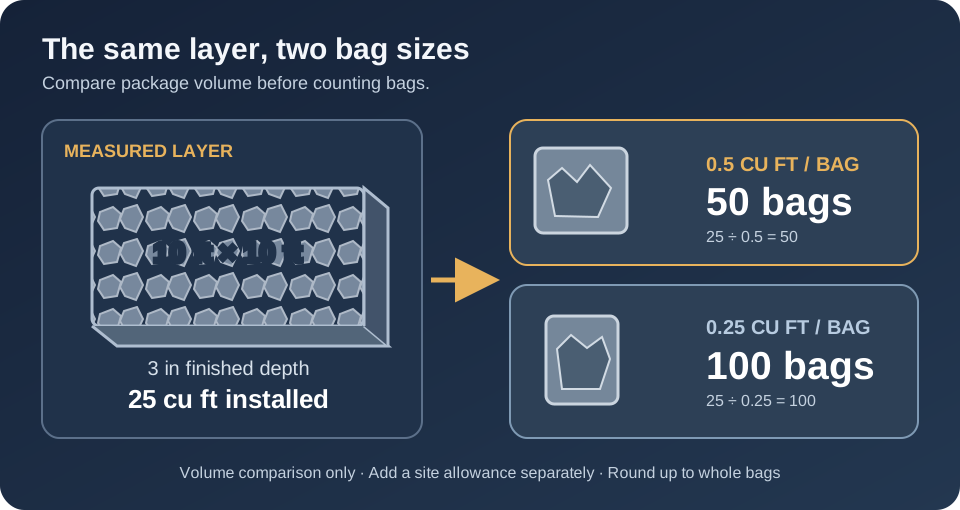
Swipe the diagram to compare bag sizes.A 10 by 10 foot stone layer at 3 inches requires 25 cubic feet: 50 bags when each holds 0.5 cubic foot, or 100 bags when each holds 0.25 cubic foot.
The same measured layer needs twice as many bags when the package volume is halved.

Match the stone to the job

“Crushed stone” on a shelf is not one grade

Open drainage layer

Look for clean, low-fines stone in the specified size range. #57 is a gradation designation, not a promise that every bag has been washed or fits your drain design. Confirm the label and the required outlet and separator for the project.

Compacted base

A crusher run or paver-base blend contains a range of particles, often with fines, to make a denser base. It is a different material from clean drain rock. Ask for the project depth and compaction specification instead of treating the calculator's depth as installation advice.

For larger work, the crushed stone calculator estimates yards and tons with an editable supplier density. This bag tool counts package volume; it does not infer a bulk tonnage from bag weight.

Before leaving the store

Make the count usable on site

  1. Measure only the area receiving stone. Split an irregular pad or path into rectangles and add their square feet. Measure the intended finished depth, including low spots you will fill.
  2. Confirm bagged volume and gradation. Keep the same product across the order; a similar color or a “gravel” label may hide a different mix of sizes and fines.
  3. Choose extra deliberately. Enter an allowance for known unevenness or handling loss. If your project specification already gives a loose-to-finished factor, avoid adding it again.
  4. Compare complete local quotes. Small repairs may be easier to carry in bags; larger quantities may favor bulk. Compare the whole-bag bill with a delivered quote for a comparable product, including the supplier's minimum and drop location. See the bulk versus bagged guide.

For a pickup trip, multiply whole bags by their labeled weight and account for passengers and other cargo. NHTSA explains the vehicle tire and loading label. A number of bags is not a safe load limit.

Crushed stone bag questions

How many bags cover 100 square feet at 3 inches deep?

The installed volume is 100 × 3 ÷ 12 = 25 cubic feet. At 0.5 cubic foot per bag, divide 25 by 0.5 to get 50 whole bags before any extra allowance. At 0.25 cubic foot per bag, the same layer needs 100 bags. Use the volume printed on the product you will buy.

How many 0.5 cubic foot bags make a cubic yard?

One cubic yard is 27 cubic feet. Divide 27 by 0.5 to get 54 bags by volume. That conversion does not say that every 54 bags have the same weight or gradation as a cubic yard from a quarry.

Can I use a 50 lb bag weight to calculate coverage?

Not reliably. Bag weight is for lifting and vehicle loading; the package volume or manufacturer coverage is the useful number for area. Stone type, particle size, fines, and moisture can change pounds per cubic foot.

Should I use bagged #57 stone or bagged paver base?

Check the product description and gradation. Clean, low-fines stone is used where an open drainage layer is specified. Paver base commonly includes smaller particles and fines so it can compact. A bag called “gravel” is not automatically interchangeable with either one.

When does bulk crushed stone cost less than bags?

There is no dependable bag-count cutoff. Multiply your whole-bag count by your local bag price, then compare it with an all-in quote for a comparable bulk stone and quantity. Include the supplier minimum, delivery, bag transport, and where you can unload.

Quarry Knowledge Network

Complete Landscape Aggregate Calculator Library

Explore material calculators, unit conversions, and practical field guides by project.

Material Calculators (20)

Core Landscape Rocks
Specialty and Base Aggregates

Conversion Calculators (28)

Generic Volume and Weight
Material Specific Conversions

River Rock Coverage Calculator

Coverage Solver

Convert river rock tons, yards, or bags to area at your depth and supplier bulk weight.

Gravel Tons Calculator

Tons Solver

Estimate US short tons with a supplier-specific loose bulk density.

Gravel Cubic Yards Calculator

Yards Solver

Measure finished gravel volume and plan a rounded bulk-yard order.

Gravel Bag Calculator

Bag Solver

Count bags by labeled volume and compare current bag and bulk quotes.

Crushed Stone Tons Calculator

Tons

Estimate short tons from depth and editable supplier bulk weight.

Crushed Stone Yardage Calculator

Yards

Round cubic yards to a supplier increment and plan delivery capacity.

Crushed Stone Bag Calculator

Bags

Count whole bags using the product label and compare local quotes.

River Rock Tons Calculator

Tons Solver

Estimate US short tons from measured area, depth, and editable supplier bulk weight.

River Rock Cubic Yard Calculator

Yards Solver

Separate installed yards from extra and round a bulk order to the supplier increment.

River Rock Bag Calculator

Bag Solver

Count bags from their labeled volume and compare current bag and bulk quotes.

Pea Gravel Patio Calculator

Patio Solver

Estimate separate pea gravel and base layers with editable depths and planning assumptions.

Pea Gravel Tons Calculator

Tons Solver

Estimate US short tons for a measured pea gravel layer with editable loose bulk density.

Pea Gravel Cubic Yard Calculator

Yards Solver

Separate measured layer volume from optional extra cubic yards for a bulk order.

Pea Gravel Bag Calculator

Bag Solver

Count retail pea gravel bags using the volume printed on your chosen bag.

Pea Gravel Coverage Calculator

Coverage Solver

Convert pea gravel tons, yards, or bags to area, or estimate an order from area and depth.

Decomposed Granite Tons Calculator

Tons Solver

Convert finished DG layer volume to loose order yards and short tons with editable assumptions.

Decomposed Granite Coverage Calculator

Coverage Solver

Estimate finished DG area per loose cubic yard or short ton at a chosen depth.

Lava Rock Bag Calculator

Bag Solver

Count whole landscape-lava bags from the label volume and estimate carrying weight.

Lava Rock Coverage Calculator

Coverage Solver

Convert known lava-rock yards, tons, or bags to area at a chosen depth.

Marble Chips Bag Calculator

Bag Solver

Count whole white marble chip bags from the volume printed on the chosen product.