Why the number works
Convert the space the loose stone will fill
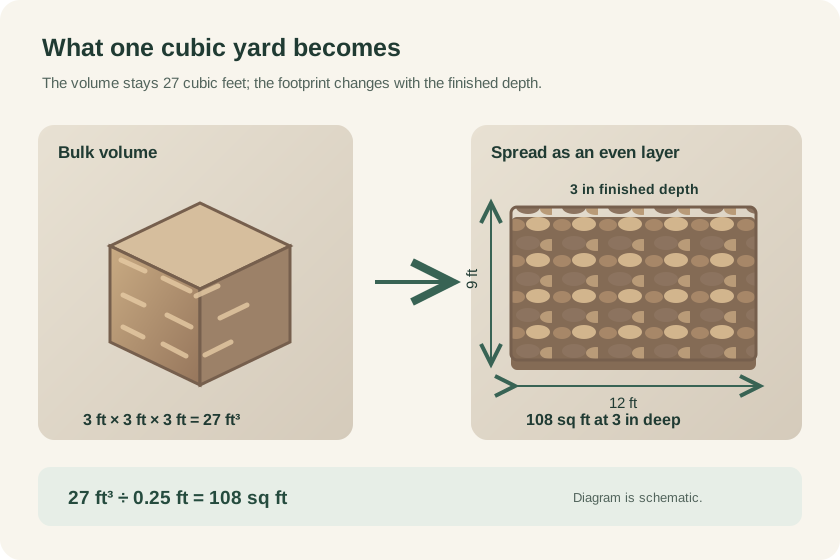
A cubic yard is a 3 × 3 × 3 ft volume: 27 cubic feet. For a rectangular bed, multiply its length and width in feet, then multiply by the finished depth in inches and divide by 324. The 324 accounts for 12 inches per foot and 27 cubic feet per yard.
installed yd³ = length (ft) × width (ft) × depth (in) ÷ 324yards with extra = installed yd³ × (1 + extra % ÷ 100)Example: 20 × 10 ft = 200 sq ft. At 3 in, 200 × 3 ÷ 324 = 1.85 yd³ installed. Adding 10% makes 2.04 yd³. A yard selling quarter-yard increments would round that to 2.25 yd³; ask whether it sells smaller increments before ordering.
Coverage is depth-dependent
Choose a finished depth before using a coverage chart
One cubic yard covers 324 ÷ depth in inches square feet in an even layer. These are volume relationships, independent of stone weight. Size labels describe individual pebbles or a screened range; they are not a depth instruction. Set a few stones on the prepared surface to see whether the layer hides soil without looking piled up.
| Finished depth | 1 yd³ covers | Yards for 200 sq ft |
|---|---|---|
| 2 in | 162 sq ft | 1.23 yd³ |
| 3 in | 108 sq ft | 1.85 yd³ |
| 4 in | 81 sq ft | 2.47 yd³ |
| 5 in | 64.8 sq ft | 3.09 yd³ |
For smaller river pebbles in a decorative bed, a 2 in starting estimate may be reasonable. A mixed 1–3 in product often begins near 3 in; larger pieces may need more depth for an even look. For one layer of large cobbles, gaps can make this blanket-volume estimate misleading: measure a sample patch and scale from it. See the rock depth guide for more context.
Real beds are rarely perfect rectangles
Measure the material still needed
Curved borders and islands
Break the footprint into short rectangles or simple shapes. Add their areas, then use the “known square footage” setting. For a curved strip, several short width measurements are better than one guess at its widest point.
Top up existing river rock
Measure the missing thickness at several spots. If the bed already has about 1 in and you want a 3 in finished layer, calculate roughly 2 in of new stone, not 3 in. Remove debris and check that the old layer is sound first.
Dry creek lining
Measure the stone-lined surface across the bottom and banks. If width or planned depth varies, divide the creek into sections and add their cubic yards. The result is a material estimate, not a hydraulic design or an erosion-control specification.
For a full creek-bed layout, use the dry creek bed guide. If you know how much rock you already have and want square feet instead, use the river rock coverage calculator.
Before the truck arrives
Check the quote against the material
- Confirm the selling unit and increment. Some yards quote cubic yards; others quote US short tons. A cubic-yard amount is volume. Tons require the product's loose bulk weight to convert accurately.
- Ask about the exact stone size and weight. Natural river rock is screened into ranges, not identical pieces. Compare a sample to your planned depth. This page uses 2,700 lb/yd³ as an editable planning value; a supplier may quote a different weight.
- Plan the delivery and unloading spot. Confirm the supplier's truck access, drop location, minimum load, and whether different materials need separate deliveries. Keep the rock pile clear of drains and sensitive planting.
Supplier examples: Landscape Centre lists river rock at about 2,600 lb/yd³ and notes that rounded stone remains loose; Newton Rock & Mulch lists about 80 sq ft per short ton at 3 in. These support a planning range, not a guarantee for the stone delivered to you.
River rock cubic yard questions
How many cubic yards of river rock cover a 10 × 20 ft bed?
At a finished depth of 3 inches, a 200-square-foot bed needs 1.85 cubic yards before extra. Add 10% and the estimate becomes 2.04 cubic yards. If your supplier sells only quarter yards, round that order up to 2.25 cubic yards.
How many square feet does one cubic yard of river rock cover?
By volume, one cubic yard covers 162 square feet at 2 inches deep, 108 square feet at 3 inches, or 81 square feet at 4 inches. These are even-layer estimates before an ordering allowance.
Does the size of river rock change cubic yards?
The volume formula does not change, but stone size affects the finished depth you choose. A 1–3 inch product name describes the stone, not a mandatory 3-inch layer. Large cobbles placed in one layer may leave gaps, so test a measured sample patch.
How do I convert river rock cubic yards to tons?
Multiply cubic yards by the product’s loose bulk weight in pounds per cubic yard, then divide by 2,000 for US short tons. The calculator starts at 2,700 lb/yd³ as a planning assumption; replace it with the weight your supplier quotes.
Should I calculate a top-up from the full rock-bed depth?
No. If sound rock already fills part of the bed, estimate the average depth still needed to reach the finished surface. Measure several spots and calculate separate sections when the missing depth varies.