Keep these numbers beside the quote
River rock coverage per ton, yard, and bag
Each row assumes an even layer, a loose bulk weight of 1.35 US short tons per cubic yard, and a 0.5 ft³ bag. Figures exclude extra for ordering.
| Finished depth | 1 cubic yard | 1 US short ton | 1 bag (0.5 ft³) |
|---|---|---|---|
| 2 in | 162 sq ft | 120 sq ft | 3 sq ft |
| 3 in | 108 sq ft | 80 sq ft | 2 sq ft |
| 4 in | 81 sq ft | 60 sq ft | 1.5 sq ft |
| 5 in | 64.8 sq ft | 48 sq ft | 1.2 sq ft |
| 6 in | 54 sq ft | 40 sq ft | 1 sq ft |
The 120 / 80 / 60 sq ft per ton figures agree with Newton Rock & Mulch’s published river rock coverage guide. Another supplier lists its river rock at about 2,600 lb/yd³, showing why the value for your product may differ. Use the editable weight above when you have a supplier figure.
What the calculator is measuring
Coverage is volume spread to a chosen depth
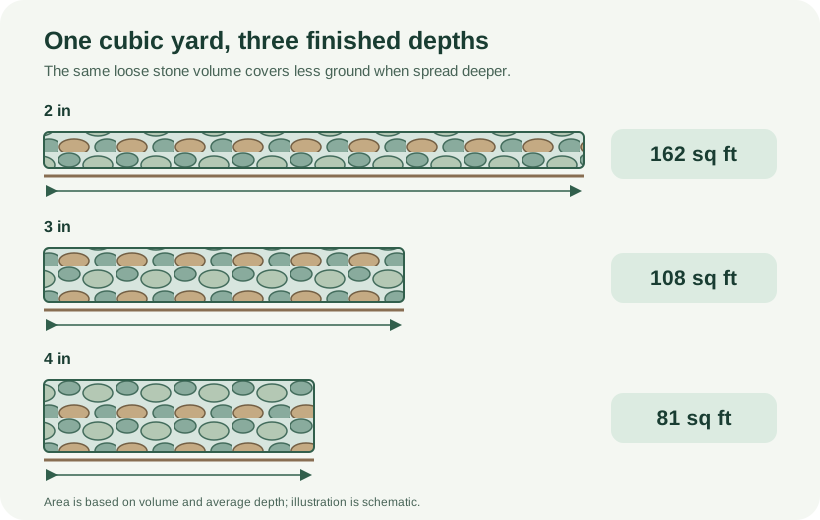
A cubic yard contains 27 cubic feet. At 3 inches deep, that volume makes a layer one quarter of a foot thick: 27 ÷ 0.25 = 108 square feet. One short ton at 1.35 short tons/yd³ is 0.741 yd³, so it covers 108 ÷ 1.35 = 80 square feet.
sq ft per yd³ = 324 ÷ depth (in)sq ft per short ton = 324 ÷ [depth (in) × tons per yd³]sq ft per bag = bag ft³ × 12 ÷ depth (in)The formulas use bulk volume and bulk weight: the spaces between loose stones are already part of the supplier’s cubic-yard quantity. They do not calculate the solid mineral volume of each rock.
For a 400 sq ft bed at 3 inches: 400 × 3 ÷ 324 = 3.70 yd³ installed. With 10% extra, order about 4.07 yd³, or 5.50 US short tons at the 1.35 tons/yd³ default. If buying 0.5 ft³ bags instead, that is 220 bags after rounding up. The extra is a user choice, not a fixed requirement for every site.
The field check
Choose depth from the actual stone, surface, and look
“1–3 inch river rock” is a size range, not an instruction to spread it 3 inches deep. Use a few stones from the actual load to test whether the soil shows through at your intended depth. A mixed-size product can fill gaps differently from a uniform large cobble. The table is a starting estimate; a sample patch is the better guide to the finished appearance.
Small river pebbles
For a decorative border, start your estimate near 2 inches, then rake a sample area level and check for bare spots.
1–3 inch river rock
Start near 3 inches for a broad bed. Adjust the layer when the actual grading leaves visible soil or an uneven surface.
Large cobbles
For a single visible layer, measure the average installed thickness across a trial patch. Gaps may be intentional, so a blanket-volume estimate has greater uncertainty.
For a single layer of cobbles: mark a small, measured area, place the actual stones to the look you want, and ask the supplier to weigh or measure the amount used. Multiply that amount by your full area divided by the patch area. This avoids pretending that a 6–10 inch size label tells you the layer depth or the coverage by weight.
Rounded rock does not lock together like angular aggregate. A border helps keep it in a bed, while a frequently walked surface may call for a different material. See the rounded versus angular rock guide. A dry creek or swale also needs a site-specific look at flow and stone stability; the dry creek bed guide covers that planning context.
Three checks before buying
Make the estimate match the supplier’s product
- Confirm the selling unit. One US short ton is 2,000 lb. One cubic yard is a volume, so converting between them requires that product’s loose bulk weight. Check the density guide if the quote only lists pounds per yard.
- Check the bag volume. A 0.5 ft³ bag covers 2 sq ft at 3 inches by volume, but retail bags come in other volumes and weights. Read the label before scaling up a bag count.
- Allow for the site. Uneven grade, edges, and the look you want can change how much you spread. If the area varies, divide it into sections, estimate each depth separately, then add the quantities.
A rock layer is not a promise of a weed-free bed. Colorado State University Extension’s mulching guide distinguishes small gravel used as mulch from larger decorative stone and cautions against woven weed-barrier fabric beneath mulch in landscape beds. Its weed management guide notes that seeds can germinate above fabric and become difficult to remove. Keep organic debris out of the rock and consider nearby plants when choosing material.
River rock coverage questions
How many square feet will one ton of river rock cover?
At an assumed loose bulk weight of 1.35 US short tons per cubic yard, one short ton covers about 120 square feet at 2 inches, 80 square feet at 3 inches, or 60 square feet at 4 inches. These are volume-based estimates before any ordering allowance. Ask your supplier for its product weight and coverage guidance.
How much ground does one cubic yard of river rock cover?
One cubic yard covers 162 square feet at 2 inches deep, 108 square feet at 3 inches, or 81 square feet at 4 inches. Those figures come from volume and do not depend on weight. Actual visual coverage depends on how evenly the stone is spread.
Is a 3-inch rock a 3-inch-deep layer?
No. The product size describes individual stones or a size range; layer depth is the average thickness of the installed bed. With large cobbles placed in a single layer, gaps and irregular shapes make a volume estimate less reliable. Set a few stones on a measured patch or ask the yard for coverage for that specific product.
How many 0.5-cubic-foot bags cover 100 square feet at 3 inches?
The bed needs 25 cubic feet of rock, so it takes 50 bags if each bag contains 0.5 cubic foot. Add any extra you want to order separately and check the volume printed on the actual bag; bag weight alone does not define its volume.
Will more river rock or landscape fabric permanently stop weeds?
No permanent weed-free result is guaranteed. Weed seeds can germinate in material that collects above rock or fabric. Colorado State University Extension advises against woven weed-barrier fabric beneath mulch in landscape beds because it can clog, interfere with air and water exchange, and make new weeds harder to remove. Keep leaves and sediment out of the rock and maintain the bed.