The order path
From finished path to truck-scale weight
Keep finished volume, loose order volume, and delivered weight separate. They answer different questions, and the last step changes when the supplier’s DG is heavier or lighter.
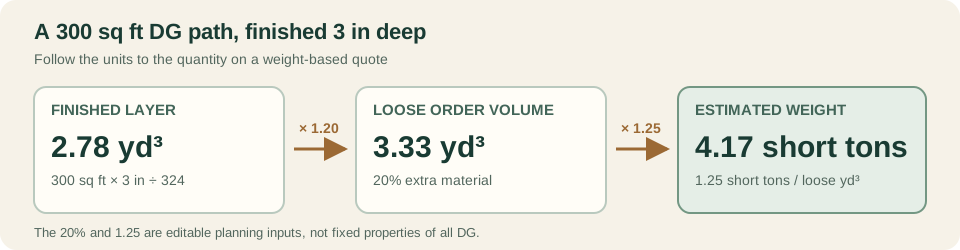
Use the same steps for any rectangle
- Finished cubic yards = length (ft) × width (ft) × finished DG depth (in) ÷ 324.
- Loose order cubic yards = finished cubic yards × (1 + extra material % ÷ 100).
- US short tons = loose order cubic yards × loose bulk density (short t/yd³).
For a 30 × 10 ft path at 3 in: 300 × 3 ÷ 324 is about 2.78 finished yd³. Applying 20% extra to the unrounded figure gives 3.33 loose order yd³; multiplying that unrounded value by 1.25 gives 4.17 short tons.
Make the quote fit the job
Three numbers to check before calling the yard
Finished DG depth
Use the depth of the compacted DG wearing layer, not the full excavation. A separate road-base layer has its own material, thickness, and density. For irregular shapes, split the space into rectangles, calculate each, and add the areas.
Extra material
The 20% starter adds order volume for the difference between a neat finished rectangle and material needed on site. It is not a universal 20% loss during compaction. Product gradation, moisture, subgrade, and grading affect what actually happens.
Loose weight per yard
Ask for the weight of one loose cubic yard of the exact product quoted. Our 1.25-short-ton preset equals 2,500 lb/yd³. A supplier’s quoted density or coverage per ton should replace it, especially for a stabilized blend or a different gradation.
ASTM C29/C29M defines a method for loose and compacted aggregate bulk density. The standard cautions that test density does not necessarily match stockpile or truck compaction and moisture, so the number for your delivered material matters.
What changes the tons?
Same path, different bulk weights
For the 300 sq ft, 3 in example with 20% extra, the loose order stays at 3.33 yd³. Only the estimated weight changes below.
| Loose density | Estimated short tons | Estimated pounds |
|---|---|---|
| 1.20 short t/yd³ | 4.00 | 8,000 |
| 1.25 short t/yd³ page preset | 4.17 | 8,333 |
| 1.35 short t/yd³ | 4.50 | 9,000 |
| 1.50 short t/yd³ | 5.00 | 10,000 |
The preset is a planning value, not a standard DG weight. Gravelshop lists 2,410 lb/yd³ for one ½-in-minus DG; Central Texas Materials lists 2,700 lb/yd³ for its fines-to-⅜-in DG. Supplier figures can also change with moisture. If your quote is by the ton, ask whether “ton” means a 2,000-lb US short ton.
Order and installation
Turn the estimate into a delivery request
Tell the supplier
- The DG product or gradation you want, such as ¼-in-minus with fines.
- Your estimated US short tons and loose cubic yards.
- The finished DG depth, delivery address, and unloading access.
- Whether they sell by scale weight, full or half yards, or a minimum load.
Keep the product instructions separate
Plain DG and stabilized pathway mix have different installation specifications. For one example, Kafka Granite’s stabilized mix calls for a 3-in compacted pedestrian layer and a 4-in vehicular layer with its specified base and moisture process. Use the depth and compaction method for the product you actually buy.
After delivery, the scale ticket’s net weight is the real purchased weight. Compare it with the estimate and check the installed finish depth at several places before ordering more.
Decomposed granite tonnage questions
How many tons of decomposed granite do I need for a 30 by 10 foot path?
At a 3-inch finished depth, 300 square feet needs 2.78 cubic yards of finished volume. With 20% extra material, the estimated loose order is 3.33 cubic yards. At 1.25 US short tons per loose cubic yard, that is 4.17 short tons, or about 8,333 pounds. Replace the allowance and density with figures for the DG you will buy.
How many tons are in a cubic yard of decomposed granite?
There is no single conversion for every decomposed granite product. This calculator starts at 1.25 US short tons, or 2,500 pounds, per loose cubic yard. Gradation, moisture, and the seller’s material can change the weight. Ask for your supplier’s loose cubic-yard-to-ton conversion.
How much does one ton of decomposed granite cover at 3 inches?
With this page’s 1.25-short-ton-per-loose-yard density and 20% extra-material presets, one US short ton supports about 72 square feet at a 3-inch finished depth. Without the extra-material allowance, mathematical coverage would be 86.4 square feet. Use the supplier’s figures for an actual order.
Is a 20% compaction allowance always required?
No. The 20% input is an editable ordering allowance, not a measured shrinkage rate or product specification. It can cover the gap between finished geometric volume and the loose quantity you buy, including placement and grade variation. Follow your product’s installation instructions or a field trial to choose a better value.
Does this tonnage include a road-base layer?
No. It estimates only the decomposed granite layer entered in the depth field. If a pathway or driveway design requires a separate compacted base, calculate that material independently using its own depth and density.