Retail marble chip planning

Marble Chips Bag Calculator: Bags, Coverage & Cost

A 10 × 10 ft bed at 2 inches needs 34 half-cubic-foot bags for the finished layer, or 37 with 10% extra. Enter your bag’s actual labeled volume to get the right whole-bag count.

Material:Bagged white marble chips
Bag volume:Read the product label; 0.5 cu ft example
Bag weight:Optional label input for carrying load
34 bags
100 sq ft at 2 in
0.5 cu ft bags, before any extra.
37 bags
Same bed with 10% extra
Round the purchase up to whole bags.
0.4 or 0.5
Common labeled cu ft
Enter the volume printed on the product you chose.

Count the bags on your shopping list

Measure the bed within its edge, choose a finished depth, and copy the volume printed on the exact bag you plan to buy. Bag weight and store price are optional: they estimate lifting load and material cost without changing coverage.

Area and bag label

Some marble products are 0.4 cu ft. Check your bag.

Whole-bag purchase

0
Bags to buy
Rounded up to whole bags
0.0
Finished cu ft
Before allowance
0.0
Order cu ft
After allowance
—
Estimated bag cost
Add local price to estimate cost.
—
Estimated carrying load
Add label weight to estimate load.

Cost excludes tax and delivery. Bag weight is based on the label you enter; the count itself uses labeled cubic feet. Check vehicle payload before transporting a large order.

A 10 × 10 ft bed, two ways

At 2 inches deep, 100 sq ft takes 16.7 cu ft in the finished layer. Add 10% for edges and uneven spots to plan 18.3 cu ft. Dividing by a 0.5 cu ft label gives 36.7, so buy 37 whole bags. A 0.4 cu ft product needs 46 bags for the same planned volume. The bag’s printed volume, not its pound rating, decides coverage.
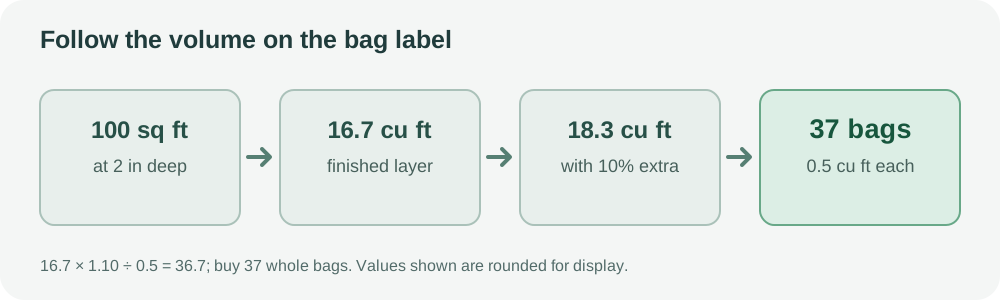
Calculation flow: 100 square feet at two inches needs 16.7 cubic feet, 18.3 with ten percent extra, and 37 whole bags labeled 0.5 cubic feet.
Order allowance is applied before dividing by the bag’s labeled volume. Always round the purchase up. Swipe the diagram to see its full width.
Finished cu ft = length (ft) × width (ft) × depth (in) ÷ 12Bags = round up [finished cu ft × (1 + allowance ÷ 100) ÷ bag cu ft]Material cost = whole bags × local price per bag

Coverage by bag volume and depth

These are geometric volumes before extra for edges or uneven ground. Compare both the stated volume and coverage on the exact bag. If they disagree, ask the seller to clarify and plan with the more cautious yield until you know which figure applies.

Square feet covered by one bag before allowance
Finished depth0.5 cu ft bag0.4 cu ft bag
1.5 in4.0 sq ft3.2 sq ft
2 in3.0 sq ft2.4 sq ft
3 in2.0 sq ft1.6 sq ft

What labels actually say: Vigoro at Home Depot lists 0.5 cu ft and 50 lb, consistent with its 2 sq ft coverage at 3 inches. A Lowe’s off-white marble listing says 0.4 cu ft and 45 lb, but also claims 3 sq ft at 2 inches; 0.4 cu ft geometrically covers only 2.4 sq ft at that depth. Confirm a conflicting yield with the seller before buying. Use the selected bag’s actual volume and weight rather than assuming every marble product is alike.

Decide between bags and a bulk delivery

Bags for access and small areas

Whole bags are convenient for a narrow side yard, a planter refresh, or a bed far from a truck drop. Multiply the rounded bag count by the current local price, then add taxes or delivery. If the label says 50 lb, 37 bags are about 1,850 lb of bags to move; confirm the vehicle’s actual payload and plan more than one trip when needed.

Bulk for a large, open bed

For a large project, compare the full delivered bulk quote with the bag total, including minimum quantity and unload location. Use the marble chips calculator to estimate cubic yards and supplier-specific loose short tons. A nominal 54 half-cubic-foot bags occupy one cubic yard, but their combined labeled weight is not a universal bulk-density measurement.

White marble is a carbonate stone. Mississippi State Extension cautions against stone mulch near acid-loving plants and notes heat and reflected light. A fabric layer will not permanently stop weeds that grow in debris above it. Keep chips away from stems and clean leaf litter from the surface.

Bagged marble chips questions

How many marble chip bags cover a 10 × 10 ft area at 2 inches?

A 100-square-foot bed needs 16.7 cubic feet in the finished layer. That is 34 whole 0.5-cubic-foot bags with no extra, or 37 bags with a 10% order allowance. If the label says 0.4 cubic foot, the 10% order is 46 bags.

How much ground does one 0.5 cu ft bag cover?

By volume, one 0.5-cubic-foot bag covers 4 square feet at 1.5 inches, 3 square feet at 2 inches, or 2 square feet at 3 inches. Actual appearance depends on chip size and the surface below. If a printed coverage claim disagrees with the bag’s stated volume, ask the seller to clarify before ordering.

How many 0.5 cu ft bags equal one cubic yard?

One cubic yard is 27 cubic feet, so it contains the same nominal volume as 54 bags of 0.5 cubic foot. Weight is product-specific and cannot be determined from bag volume alone.

Can I calculate bags from a 50-pound label alone?

Use the bag’s stated volume for coverage. Pounds tell you the estimated carrying load once the bag count is known. They do not by themselves state how much area the product covers.

Quarry Knowledge Network

Complete Landscape Aggregate Calculator Library

Explore material calculators, unit conversions, and practical field guides by project.

Material Calculators (20)

Core Landscape Rocks
Specialty and Base Aggregates

Conversion Calculators (28)

Generic Volume and Weight
Material Specific Conversions

River Rock Coverage Calculator

Coverage Solver

Convert river rock tons, yards, or bags to area at your depth and supplier bulk weight.

Gravel Tons Calculator

Tons Solver

Estimate US short tons with a supplier-specific loose bulk density.

Gravel Cubic Yards Calculator

Yards Solver

Measure finished gravel volume and plan a rounded bulk-yard order.

Gravel Bag Calculator

Bag Solver

Count bags by labeled volume and compare current bag and bulk quotes.

Crushed Stone Tons Calculator

Tons

Estimate short tons from depth and editable supplier bulk weight.

Crushed Stone Yardage Calculator

Yards

Round cubic yards to a supplier increment and plan delivery capacity.

Crushed Stone Bag Calculator

Bags

Count whole bags using the product label and compare local quotes.

River Rock Tons Calculator

Tons Solver

Estimate US short tons from measured area, depth, and editable supplier bulk weight.

River Rock Cubic Yard Calculator

Yards Solver

Separate installed yards from extra and round a bulk order to the supplier increment.

River Rock Bag Calculator

Bag Solver

Count bags from their labeled volume and compare current bag and bulk quotes.

Pea Gravel Patio Calculator

Patio Solver

Estimate separate pea gravel and base layers with editable depths and planning assumptions.

Pea Gravel Tons Calculator

Tons Solver

Estimate US short tons for a measured pea gravel layer with editable loose bulk density.

Pea Gravel Cubic Yard Calculator

Yards Solver

Separate measured layer volume from optional extra cubic yards for a bulk order.

Pea Gravel Bag Calculator

Bag Solver

Count retail pea gravel bags using the volume printed on your chosen bag.

Pea Gravel Coverage Calculator

Coverage Solver

Convert pea gravel tons, yards, or bags to area, or estimate an order from area and depth.

Decomposed Granite Tons Calculator

Tons Solver

Convert finished DG layer volume to loose order yards and short tons with editable assumptions.

Decomposed Granite Coverage Calculator

Coverage Solver

Estimate finished DG area per loose cubic yard or short ton at a chosen depth.

Lava Rock Bag Calculator

Bag Solver

Count whole landscape-lava bags from the label volume and estimate carrying weight.

Lava Rock Coverage Calculator

Coverage Solver

Convert known lava-rock yards, tons, or bags to area at a chosen depth.

Marble Chips Bag Calculator

Bag Solver

Count whole white marble chip bags from the volume printed on the chosen product.