Retail bag planning

Pea Gravel Bag Calculator

A 12 × 12 ft area at 2 inches needs 48 half-cubic-foot bags before extra, or 53 with a 10% allowance. Enter your bag's labeled volume below; its weight alone does not tell you its coverage.

Material:Bagged pea gravel
Order unit:Bag volume printed on the label
Default bag:0.5 cubic foot
3 sq ft
One 0.5 ft³ bag
Coverage at a level 2-inch depth, before extra
54 bags
One cubic yard
Volume equivalent for 0.5 ft³ bags
53 bags
12 × 12 ft example
At 2 inches with a chosen 10% extra allowance

Build your bag order

Measure the finished surface, choose its pea gravel depth, then read the cubic feet printed on the bag. The 10% extra is an editable planning choice for edges, uneven spots or spillage.

Project and package

Use the bag's stated volume for coverage. Enter 0% for exact geometric volume, or add only what suits your site.

Optional store and delivery details

For a fair comparison, include your bag order's tax and transport and use a bulk quote that includes the supplier's minimum, delivery, taxes and fees for at least the planned volume.

Your purchase estimate

Whole bags to buy53at 0.5 ft³ per bag
Area144 sq ft
Net fill volume24.0 ft³
Planned volume26.4 ft³
Planned cubic yards0.98 yd³
One bag covers3.0 sq ft
Bag order totalAdd price

Enter the labeled bag weight to estimate your carry load.

Enter both a bag price and a delivered bulk quote to compare this order.

Bag count rounds up once, after the extra allowance. Coverage per bag is geometric and excludes the extra allowance.

Bag label → ground coverage

A cubic foot is a volume, not an area

A half-cubic-foot bag covers 3 square feet at 2 inches or 2 square feet at 3 inches. Spread it thinner and the footprint grows; spread it deeper and the footprint shrinks. The coverage assumes a level layer and uses no extra allowance.

NorthRock's pea gravel product sheet lists a ½ ft³ bag at up to 3 sq ft at 2 inches, which matches the geometry.
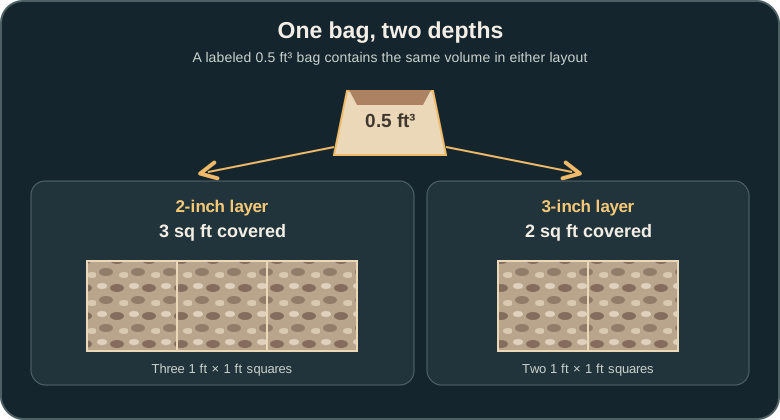
A 0.5 cubic foot bag spread over 3 square feet at 2 inches deep, or 2 square feet at 3 inches deep.
Same bag volume. A deeper layer covers less area.

Coverage by bag size and depth

Use this table when reading a store label or checking a carton quantity. Each cell is the ideal square feet covered by one bag; project orders still need whole bags.

Square feet covered per bag, before any extra allowance
Pea gravel depth0.5 ft³ bag0.6 ft³ bag
1.5 in4.0 sq ft4.8 sq ft
2 in3.0 sq ft3.6 sq ft
2.5 in2.4 sq ft2.9 sq ft
3 in2.0 sq ft2.4 sq ft

The second column matches common half-cubic-foot listings, including this Lowe's pea gravel listing. A Sakrete technical sheet gives approximately 0.6 ft³ for one of its 50 lb bags. Read the product in your hand; pounds alone are not a reliable bag-size input.

Worked order

Calculate volume, add extra, then round once

Net ft³ = area (sq ft) × depth (in) ÷ 12Planned ft³ = net ft³ × (1 + extra % ÷ 100)Bags = round up (planned ft³ ÷ labeled ft³ per bag)

For a 12 × 12 ft space at 2 inches, the surface requires 144 × 2 ÷ 12 = 24 ft³. A chosen 10% extra makes that 26.4 ft³. With a bag labeled 0.5 ft³, 26.4 ÷ 0.5 = 52.8, so buy 53 whole bags. Without extra, the same space needs 48 bags.

For a curved bed, divide it into measured sections or use its known square footage in the calculator. If the subgrade has low spots, measure the extra fill separately; a flat-area formula cannot discover them. The pea gravel coverage calculator solves the reverse question when you already know the quantity on hand.

At the supplier

Three checks before loading the bags

  1. Read the volume line. If it says 0.5 ft³, use 0.5. If it says 0.6 ft³, use 0.6. A weight-only label needs a product yield or supplier confirmation before you can calculate precise coverage.
  2. Check the stone and depth. Rounded pea gravel can move underfoot, so plan a suitable border as University of Maine Extension advises for gravel paths and patios. A patio also needs its base calculated separately. Bag count here is for the pea gravel layer only.
  3. Plan the carry load. Multiply whole bags by the labeled pounds per bag. For 53 bags labeled 50 lb, that is 2,650 lb of product, before passengers or other cargo. Use your vehicle's payload rating or arrange delivery.

Bagged or delivered loose?

Compare the full local quotes

There is no universal bag count where bulk becomes cheaper. Bag prices, pallet discounts, a supplier's minimum order and delivery distance change the answer. Enter your local bag price, any bag pickup or delivery costs and a delivered bulk quote for at least the planned volume to compare like for like.

As a hypothetical example, 53 bags at $5.75 each cost $304.75 before sales tax and transport. A $240 delivered loose quote for the same volume would be $64.75 less before any taxes or bag transport costs. Bags may still help when access is narrow or the job is spread across several small beds. The bulk versus bagged guide covers handling and delivery tradeoffs; the pea gravel cubic yard calculator converts larger orders.

Pea gravel bag questions

How many half-cubic-foot bags cover 100 square feet?

At 2 inches deep, 100 square feet needs 16.67 cubic feet, so round 33.33 up to 34 bags labeled 0.5 cubic foot. With a 10% extra allowance, multiply the volume before rounding: 16.67 × 1.10 ÷ 0.5 = 36.67, or 37 bags. At 3 inches with no extra, it takes 50 bags.

How many 0.5 cubic foot bags make one cubic yard?

Exactly 54 by volume: 1 cubic yard is 27 cubic feet, and 27 ÷ 0.5 = 54. This is a volume conversion, before any extra allowance or rounding for a particular project.

Can I treat every 50-pound bag as half a cubic foot?

No. Use the volume stated on the bag to calculate coverage. A 50-pound bag may yield a different volume depending on its product and aggregate; for example, Sakrete lists approximately 0.6 cubic foot for its 50-pound pea gravel bag. Bag weight is useful for estimating the load you will carry.

How much will my pea gravel bag order weigh?

Multiply the rounded bag count by the weight printed on your bag. For the example of 53 bags, a product labeled 50 pounds per bag gives 2,650 pounds of bagged product. Enter your actual bag weight in the calculator; leave it blank if the label does not provide one.

Is the 2-inch setting suitable under playground equipment?

No. The 2-inch example is for a decorative surface, not fall protection. Playground surfacing needs a separate design based on equipment fall height, impact performance, installed depth, containment, and maintenance. Consult the current CPSC playground handbook and the surface manufacturer.

For playground surfacing, consult the current CPSC Public Playground Safety Handbook; a decorative gravel depth is not a fall-protection specification.

Quarry Knowledge Network

Complete Landscape Aggregate Calculator Library

Explore material calculators, unit conversions, and practical field guides by project.

Material Calculators (20)

Core Landscape Rocks
Specialty and Base Aggregates

Conversion Calculators (28)

Generic Volume and Weight
Material Specific Conversions

River Rock Coverage Calculator

Coverage Solver

Convert river rock tons, yards, or bags to area at your depth and supplier bulk weight.

Gravel Tons Calculator

Tons Solver

Estimate US short tons with a supplier-specific loose bulk density.

Gravel Cubic Yards Calculator

Yards Solver

Measure finished gravel volume and plan a rounded bulk-yard order.

Gravel Bag Calculator

Bag Solver

Count bags by labeled volume and compare current bag and bulk quotes.

Crushed Stone Tons Calculator

Tons

Estimate short tons from depth and editable supplier bulk weight.

Crushed Stone Yardage Calculator

Yards

Round cubic yards to a supplier increment and plan delivery capacity.

Crushed Stone Bag Calculator

Bags

Count whole bags using the product label and compare local quotes.

River Rock Tons Calculator

Tons Solver

Estimate US short tons from measured area, depth, and editable supplier bulk weight.

River Rock Cubic Yard Calculator

Yards Solver

Separate installed yards from extra and round a bulk order to the supplier increment.

River Rock Bag Calculator

Bag Solver

Count bags from their labeled volume and compare current bag and bulk quotes.

Pea Gravel Patio Calculator

Patio Solver

Estimate separate pea gravel and base layers with editable depths and planning assumptions.

Pea Gravel Tons Calculator

Tons Solver

Estimate US short tons for a measured pea gravel layer with editable loose bulk density.

Pea Gravel Cubic Yard Calculator

Yards Solver

Separate measured layer volume from optional extra cubic yards for a bulk order.

Pea Gravel Bag Calculator

Bag Solver

Count retail pea gravel bags using the volume printed on your chosen bag.

Pea Gravel Coverage Calculator

Coverage Solver

Convert pea gravel tons, yards, or bags to area, or estimate an order from area and depth.

Decomposed Granite Tons Calculator

Tons Solver

Convert finished DG layer volume to loose order yards and short tons with editable assumptions.

Decomposed Granite Coverage Calculator

Coverage Solver

Estimate finished DG area per loose cubic yard or short ton at a chosen depth.

Lava Rock Bag Calculator

Bag Solver

Count whole landscape-lava bags from the label volume and estimate carrying weight.

Lava Rock Coverage Calculator

Coverage Solver

Convert known lava-rock yards, tons, or bags to area at a chosen depth.

Marble Chips Bag Calculator

Bag Solver

Count whole white marble chip bags from the volume printed on the chosen product.